

JN0-281 Practice Exam and Study Guides - Verified By TestPassKing Updated 197 Questions
2025 Updated Verified Pass JN0-281 Study Guides & Best Courses
Juniper JN0-281 Exam Syllabus Topics:
| Topic | Details |
|---|---|
| Topic 1 |
|
| Topic 2 |
|
| Topic 3 |
|
| Topic 4 |
|
| Topic 5 |
|
NEW QUESTION # 67
What are the different OSPF area types? (Choose two)
- A. Virtual Link Area
- B. Default-Free Zone
- C. Not-So-Stubby Area (NSSA)
- D. Stub Area
Answer: C,D
NEW QUESTION # 68
What is the default route preference of a static route in the Junos OS?
- A. 0
- B. 1
- C. 2
- D. 3
Answer: C
Explanation:
In Junos OS, the default route preference for a static route is 5. Route preference values are used to determine which route should be installed in the routing table when multiple routes to the same destination are available.
Step-by-Step Breakdown:
Static Route Preference:
A static route, by default, has a preference of 5, making it a highly preferred route. Lower preference values are more preferred in Junos, meaning static routes take precedence over most dynamic routing protocol routes, such as OSPF (preference 10) or BGP (preference 170).
Route Preference:
Route preference is a key factor in the Junos routing decision process. Routes with lower preference values are preferred and installed in the forwarding table.
Juniper Reference:
Static Routes: In Junos, the default preference for static routes is 5, making them more preferred than most dynamic routes.
NEW QUESTION # 69
Which two statements are correct about rules for EBGP and IBGP? (Choose two.)
- A. EBGP peers have a TTL of 255, while IBGP peers have a TTL of 1.
- B. IBGP routes are more preferred than EBGP routes.
- C. EBGP peers have a TTL of 1, while IBGP peers have a TTL of 255.
- D. EBGP routes are more preferred than IBGP routes.
Answer: C,D
Explanation:
EBGP (External BGP) and IBGP (Internal BGP) operate with different rules due to the nature of their relationships.
Step-by-Step Breakdown:
TTL Differences:
EBGP: By default, EBGP peers have a TTL of 1, meaning they must be directly connected, or the TTL needs to be manually increased for multihop EBGP.
IBGP: IBGP peers within the same AS have a TTL of 255, as they are expected to communicate over multiple hops within the AS.
Preference for EBGP Routes:
Routes learned via EBGP are typically preferred over IBGP routes. This is because EBGP routes are considered more reliable since they originate outside the AS, while IBGP routes are internal. Juniper Reference: BGP Configuration: The different handling of TTL and route preferences between EBGP and IBGP ensures proper route selection and security within Junos-based networks.
NEW QUESTION # 70
Which signaling protocol is used for EVPN?
- A. OSPF
- B. PIM
- C. BGP
- D. IS-IS
Answer: C
Explanation:
EVPN (Ethernet Virtual Private Network) is a standard protocol used for building Layer 2 and Layer 3 VPNs over an IP or MPLS network. The signaling protocol used for EVPN is BGP (Border Gateway Protocol).
Step-by-Step Breakdown:
BGP as the EVPN Signaling Protocol:
EVPN uses BGP to exchange MAC address reachability information between routers (PE devices). This enables devices to learn which MAC addresses are reachable through which PE devices, facilitating Layer 2 forwarding across an IP or MPLS core.
BGP Extensions for EVPN:
BGP is extended with new address families (e.g., EVPN NLRI) to carry both MAC and IP address information, allowing for scalable and efficient multi-tenant network solutions. Juniper Reference: Junos EVPN Configuration: Juniper uses BGP as the control plane for EVPN to exchange MAC and IP route information between different data center devices.
NEW QUESTION # 71
Exhibit: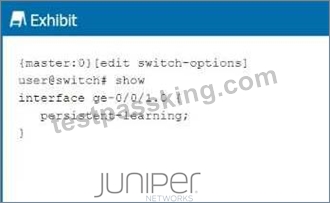
Referring to the exhibit, which behavior does this configuration enable on the ge-0/0/1.0 interface?
- A. This configuration enables a MAC address learned on the interface to be persistently retained in the Ethernet-switching table, even after a reboot.
- B. This configuration enables the device to place a MAC address that persistently causes network errors into a special protected VLAN.
- C. This configuration enables the device to shut down the interface when a particular MAC address persistently sends broadcast traffic.
- D. This configuration enables the interface to learn and remember MAC addresses, until the device is rebooted.
Answer: A
Explanation:
The configuration in the exhibit shows the persistent-learning feature enabled on interface ge-0/0/1.0.
Step-by-Step Breakdown:
Persistent Learning:
Persistent-learning ensures that the MAC addresses learned on the interface are retained in the Ethernet-switching table, even after a device reboot. This prevents the need to re-learn MAC addresses after the device restarts, improving stability and reducing downtime.
Use Case:
This feature is particularly useful in environments where the re-learning of MAC addresses could cause temporary disruptions or delays in communication, such as in critical Layer 2 network segments.
Command Example:
set switch-options interface ge-0/0/1.0 persistent-learning
Juniper
Reference: Persistent MAC Learning: In Junos, enabling persistent-learning ensures that learned MAC addresses are not lost during reboots, contributing to smoother network operations in environments where stability is crucial.
NEW QUESTION # 72
Exhibit: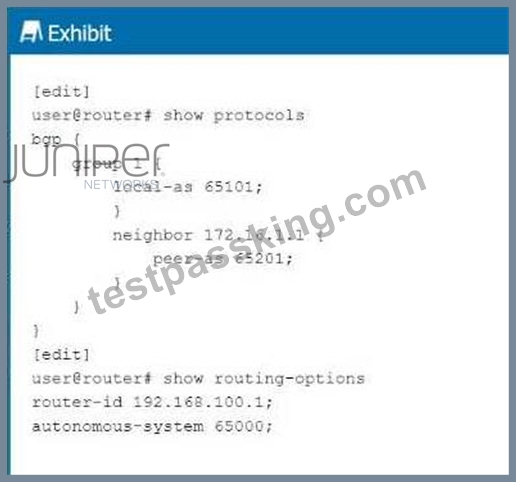
Referring to the exhibit, which statement is correct?
- A. BGP group 1 requires a type external parameter.
- B. The configuration will commit successfully and BGP group 1 will operate as IBGP.
- C. The configuration will commit successfully and BGP group 1 will operate as EBGP.
- D. BGP group 1 requires a type internal parameter.
Answer: C
Explanation:
In the exhibit, BGP is configured with local AS 65101 and a neighbor at 172.16.1.1 in peer AS 65201.
This setup involves two different Autonomous Systems (AS), indicating an External BGP (EBGP) configuration.
Step-by-Step Breakdown:
EBGP vs. IBGP:
EBGP is used between routers in different ASes. In this case, the local AS is 65101 and the peer AS is 65201, meaning the BGP session is EBGP.
IBGP is used between routers within the same AS, which is not applicable here as the AS numbers are different.
BGP Group Configuration:
The configuration does not require a type external parameter because Junos OS automatically recognizes the session as EBGP when the local and peer AS numbers are different. The BGP session will operate as EBGP, and the configuration will commit successfully.
Juniper
Reference: BGP Configuration: In Juniper, EBGP is automatically recognized when the local and peer AS numbers differ, without needing to specify type external.
NEW QUESTION # 73
What are two reasons why you would deploy an IP fabric instead of a traditional Layer 2 network in a data center? (Choose two.)
- A. IP fabrics are better suited to smaller networks where scale is less important.
- B. Layer 2 networks are susceptible to loops.
- C. Layer 3 networks support load balancing.
- D. Layer 2 networks only support a single broadcast domain.
Answer: B,C
Explanation:
IP fabrics are Layer 3-centric network designs often used in data centers due to their scalability, efficient routing, and loop-free architecture.
Step-by-Step Breakdown:
Layer 3 Load Balancing:
IP fabrics use Equal-Cost Multipath (ECMP) to distribute traffic across multiple paths, providing effective load balancing and improving bandwidth utilization. This capability is absent in traditional Layer 2 networks, which do not support ECMP for routing decisions.
Layer 2 Loops:
Layer 2 networks are prone to loops because of the lack of TTL (Time-to-Live) mechanisms. Spanning Tree Protocol (STP) is required to prevent loops, but it can introduce inefficiencies by blocking links. In contrast, IP fabrics based on Layer 3 protocols are loop-free and do not need STP. Juniper Reference: IP Fabric: Juniper's IP fabric solutions offer efficient Layer 3 routing with built-in load balancing and loop prevention, making them ideal for modern data center architectures.
NEW QUESTION # 74
Which statement is correct about areas in OSPF?
- A. OSPF areas are used to reduce the size of the link-state database.
- B. An OSPF area is used to signify the autonomous system to which each device belongs.
- C. An OSPF area is used to segment Layer 2 broadcast domains.
- D. OSPF areas are used to isolate the effects of a broadcast storm.
Answer: A
Explanation:
In OSPF (Open Shortest Path First), areas are used to segment a network into smaller, more manageable pieces to improve scalability. By dividing a network into areas, OSPF can reduce the size of the link-state database (LSDB), which helps routers process updates more efficiently.
Step-by-Step Breakdown:
Purpose of OSPF Areas:
OSPF areas allow for hierarchical routing within the OSPF domain. Routers in the same area have identical LSDBs, but routers in different areas do not exchange full link-state information. Instead, they exchange summarized routes, which reduces the LSDB size and CPU/memory usage.
Benefits:
Reducing the LSDB size improves scalability and ensures faster convergence in larger networks. Area 0 is the backbone area, and all other areas must connect to it, forming a hierarchical structure.
Juniper Reference:
OSPF Configuration: Areas in OSPF are configured to optimize network performance by limiting the scope of link-state advertisements (LSAs) to within an area.
NEW QUESTION # 75
Which statement about switches is correct?
- A. Each port is in a unique broadcast domain by default.
- B. All ports reside in the same collision domain.
- C. Every port is in a unique collision domain.
- D. Each port is a member of VLAN 2 by default.
Answer: C
Explanation:
Each port on a modern switch creates a separate collision domain. This allows multiple devices to communicate simultaneously without collisions on different ports.
Step-by-Step Breakdown:
Collision Domain:
A collision domain is a network segment where data packets can collide if two devices send packets simultaneously.
On a switch, each port creates a separate collision domain, so collisions only occur if two devices connected to the same port (through a hub, for instance) try to send data at the same time. Switches vs Hubs:
Unlike hubs, which have one large collision domain, switches isolate collisions to individual ports, improving performance.
Juniper
Reference: Switch Port Behavior: In Juniper switches, each port operates in its own collision domain, enhancing network efficiency by reducing the chances of packet collisions.
NEW QUESTION # 76
What are two characteristics of a typical EBGP underlay fabric? (Choose two.)
- A. An EBGP fabric does not require an IGP to advertise loopback IPs.
- B. An EBGP fabric relies on an IGP to advertise loopback IPs.
- C. Each device in an EBGP fabric will be configured in its own unique private AS.
- D. Each device in an EBGP fabric will be configured to be part of the same private AS.
Answer: A,C
NEW QUESTION # 77
In OSPF, which term refers to routers that have interfaces in multiple areas?
- A. Backbone Routers
- B. Autonomous System Boundary Routers (ASBRs)
- C. Internal Routers
- D. Area Border Routers (ABRs)
Answer: D
NEW QUESTION # 78
Which three technologies improve high availability and convergence in a data center network? (Choose three.)
- A. Failover Group (FG)
- B. link aggregation group (LAG)
- C. graceful restart (GR)
- D. link loss adjacency
- E. Bidirectional Forwarding Detection (BFD)
Answer: B,C,E
Explanation:
High availability and fast convergence are critical in data center networks to minimize downtime and maintain optimal performance. The following technologies contribute to achieving these goals: Graceful Restart (GR):
GR allows routers to maintain forwarding state during control plane restarts, ensuring continuous packet forwarding while minimizing network disruptions. Bidirectional Forwarding Detection (BFD):
BFD provides fast detection of path failures, allowing routing protocols to converge quickly by detecting link failures much faster than traditional timers. Link Aggregation Group (LAG):
LAG increases both redundancy and bandwidth by combining multiple physical links into one logical link, providing load balancing and fault tolerance.
Juniper
Reference: High Availability Techniques: These technologies are fundamental in ensuring rapid recovery and failover within Juniper-based data center environments.
NEW QUESTION # 79
Which EBGP feature must be used when peering to a non-directly connected peer address?
- A. multihop
- B. AS path
- C. multipath
- D. local preference
Answer: A
NEW QUESTION # 80
Which two statements are correct about aggregated Ethernet bundles? (Choose two.)
- A. You must purchase a services license for the chassis to support aggregate Ethernet interfaces.
- B. You must enable LACP when configuring aggregated Ethernet bundles.
- C. You must specify which interfaces are members of a specific aggregated Ethernet bundle.
- D. You must enable the chassis to support aggregated Ethernet interfaces.
Answer: C,D
NEW QUESTION # 81
In the Junos OS, which feature is used to create an alternate next hop with a unique preference for a static route?
- A. Resolve
- B. Next-hop
- C. Preference
- D. Qualified-next-hop
Answer: D
Explanation:
In Junos OS, the qualified-next-hop feature is used to specify an alternate next hop for a static route, along with a unique preference value.
Step-by-Step Breakdown:
Qualified-Next-Hop:
A qualified-next-hop allows you to define multiple next hops for a static route, each with its own preference. This provides flexibility by allowing the router to choose the best available next hop based on reachability and preference.
Use Case:
If the primary next hop becomes unreachable, the router can automatically switch to the alternate next hop defined by the qualified-next-hop with a higher preference value.
Command Example:
set routing-options static route 10.10.10.0/24 qualified-next-hop 192.168.1.1 preference 5 set routing-options static route 10.10.10.0/24 qualified-next-hop 192.168.1.2 preference 10 Preference:
The next hop with the lowest preference is chosen first. If it becomes unavailable, the router will use the higher preference next hop.
Juniper Reference:
Qualified-Next-Hop: This feature is used to configure backup or alternate next hops for static routes in Juniper devices.
NEW QUESTION # 82
What is the primary function of a VLAN?
- A. To segment a network into multiple broadcast domains.
- B. To encrypt network traffic.
- C. To provide a routing mechanism between different networks.
- D. To control network traffic based on MAC addresses.
Answer: A
NEW QUESTION # 83
......
Ultimate Guide to the JN0-281 - Latest Edition Available Now: https://www.testpassking.com/JN0-281-exam-testking-pass.html
2025 Updated Verified Pass JN0-281 Exam - Real Questions and Answers: https://drive.google.com/open?id=1SIvlwQka0NTrdYicQkhkyFNSS_BHPtXr