

KCNA Actual Questions - Instant Download Tests Free Updated Today!
Get instant access of 100% real Linux Foundation KCNA exam questions with verified answers
Linux Foundation KCNA Certification Exam is a vendor-neutral certification program, which means that it is not tied to any specific cloud platform or technology vendor. This makes it an excellent choice for IT professionals who want to demonstrate their expertise in Kubernetes and cloud native technologies without being limited by proprietary technologies or vendor lock-in.
NEW QUESTION # 48
Explain the difference between a Docker image and a Docker container. Provide practical scenarios where they are used.
- A. Docker images and containers are the same thing, just different names.
- B. A Docker image is a blueprint for creating a container, while a container is a running instance of that image.
- C. Docker images are used for storing data, while containers are used for running applications.
- D. A Docker container is a blueprint for creating an image, while an image is a running instance of that container.
- E. Docker images are used for running applications, while containers are used for storing data.
Answer: B
Explanation:
A Docker image is a static, immutable template that contains all the necessary components (files, libraries, dependencies, etc.) to run a specific application. Think of it as a blueprint. A Docker container is a running instance of that image, meaning it's an actual process running on your system. You can create multiple containers from the same image. Practical Scenarios: Image: You create a Docker image for a web server application, including the web server software, configuration files, and application code. This image can be shared with others or deployed to different environments. Container: You run multiple instances of this web server image as containers on your server. Each container gets its own isolated environment, allowing you to scale your web application easily.
NEW QUESTION # 49
Your application requires a specific storage class for its persistent dat
a. How do you configure this storage class within your deployment YAML?
- A. Specify the storage class name directly within the 'spec.template.spec.containers[0].volumeMounts[0].name' field of the deployment.
- B. Create a separate PersistentVolumeClaim (PVC) with the desired storage class and reference the PVC in the deployment's name' field.
- C. None of the above
- D. Specify the storage class name within the 'spec.template.spec.containers[01.volumeMounts[0].storageClassName' field of the deployment.
- E. Specify the storage class name within the field of the deployment.
Answer: B
Explanation:
The correct approach is to create a separate PersistentVolumeClaim (PVC) that specifies the desired storage class and reference the PVC in the deployments 'spec_template.spec_containers[0]_volumeMounts[0]_name' field. This ensures the PVC is automatically bound to a PV with the correct storage class. Specifying the storage class name directly within the deployment or the volumeMounts section is not the standard practice for defining storage requirements.
NEW QUESTION # 50
What kind of limitation cgroups allows?
- A. Prioritization
- B. Server cpu and memory
- C. Resource limiting
- D. Control
- E. None of the options
- F. Accounting
Answer: A,C,D,F
NEW QUESTION # 51
You are troubleshooting a performance issue with an application running in a Kubernetes cluster. You have access to Prometheus and Jaeger, but the Jaeger Ul shows that a specific request took an unusually long time to process. Which metric in Prometheus can help you identify the specific component or service within the application that caused the delay?
- A. kube_pod_container_resource_requests_cpu_cores
- B. http_request_duration_seconds
- C. kube_deployment_status_replicas
- D. kube_pod_status_phase
- E. kube_pod_container_status_restart_count
Answer: B
Explanation:
The correct answer is E . The metric 'http_request_duration_seconds* is typically used to track the time taken for HTTP requests to be processed. In this case, by looking at the 'http_request_duration_seconds' metric for the specific request identified in Jaeger, you can see the duration of each stage of the request processing. This can pinpoint the specific component or service where the delay occurred. The other options are not relevant to identifying the specific component or service causing the delay: A : Shows CPU resource requests for a pod. B : Shows the pod's phase. C : Shows the number of replicas in a deployment. D : Shows the restart count for a pod's containers. These metrics do not provide information about the processing time of individual requests.
NEW QUESTION # 52
What is Open Container Initiative 'OCI'?
- A. An organization that creates open standards for containers
- B. A protocol for communicating with the kubernetes api
- C. An open standard for managing service mesh in kubernetes
- D. The governing body of the Cloud Native Computing Foundation 'CNCF'
Answer: A
Explanation:
https://opencontainers.org/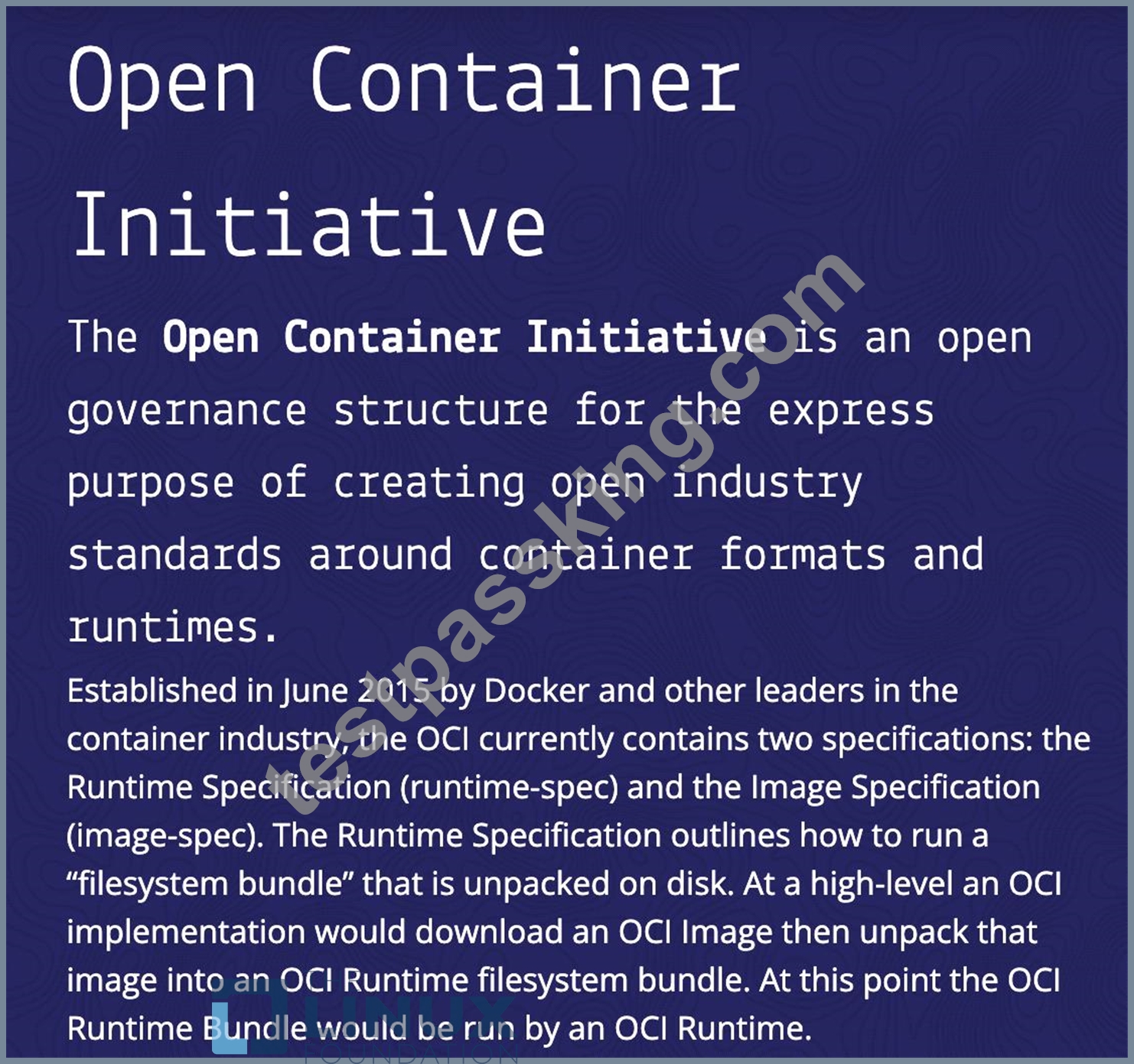
NEW QUESTION # 53
Have a pod 'hello' and a container in that pod 'green'. Which of the following commands would get the logs for that container?
- A. alias k='kubectl'
k logs -p hello green - B. alias k='kubectl'
k logs -p hello -c green - C. alias k='kubectl'
k get logs -p hello -c green - D. alias k='kubectl'
k logs hello -c green
Answer: D
Explanation:
https://kubernetes.io/docs/reference/generated/kubectl/kubectl-commands#logs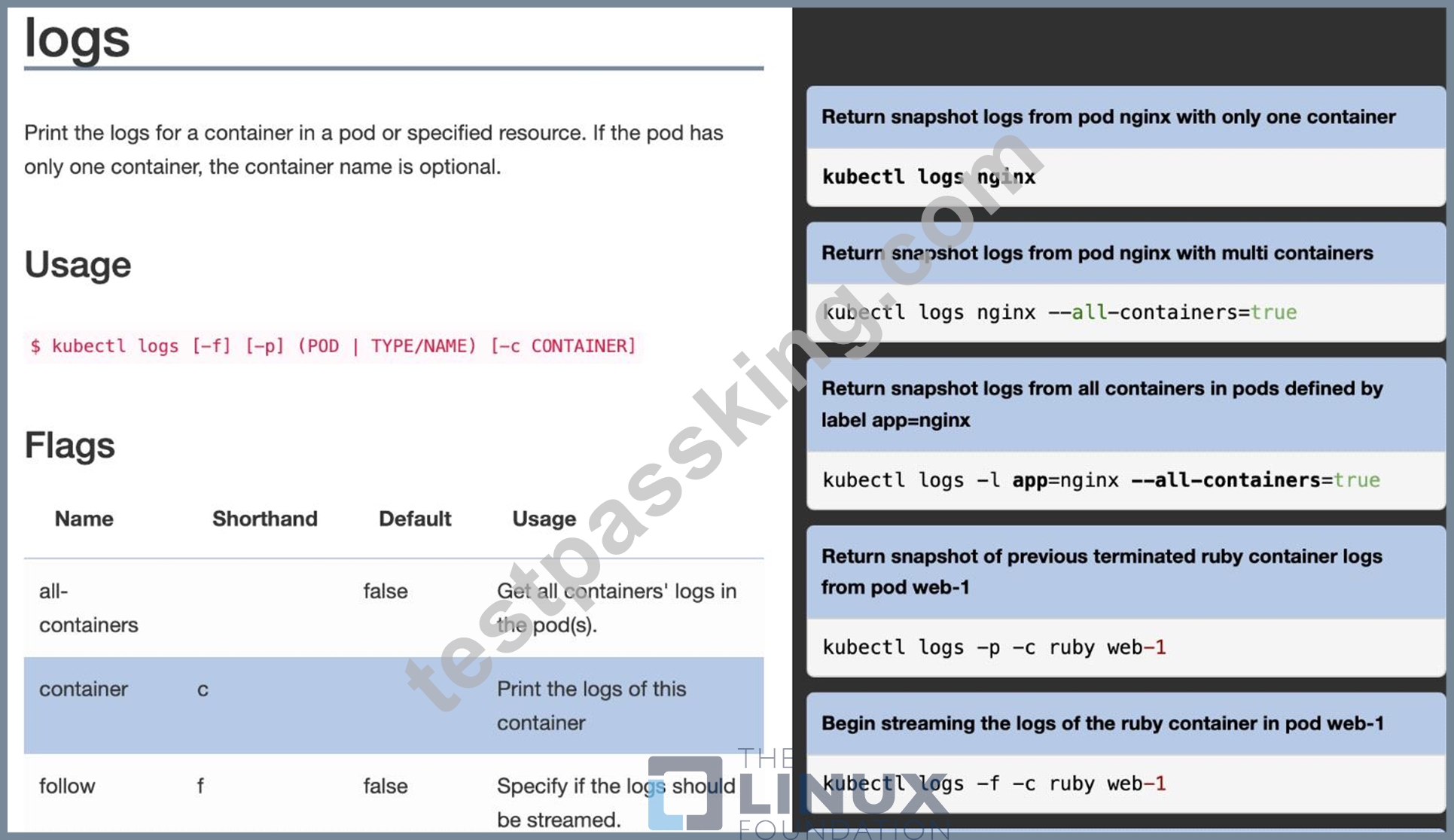
NEW QUESTION # 54
Which authentication method allows JWTs to authenticate?
- A. OpenId connect
- B. Anonymous
- C. OPA gatekeeper
- D. Client 'TLS' certificates
Answer: A
NEW QUESTION # 55
How does service logical group set of pods?
- A. Using label and selectors
- B. Using IP address
- C. Using hostname
Answer: A
Explanation:
https://kubernetes.io/docs/concepts/services-networking/service/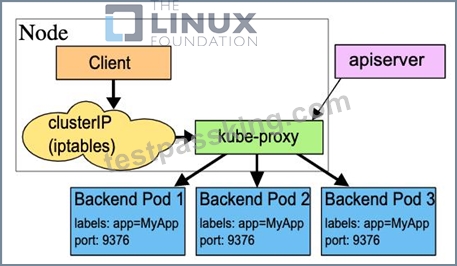
NEW QUESTION # 56
You have deployed an application in Kubernetes with a container image that has known vulnerabilities. Which of the following security measures is MOST effective in mitigating the risk of these vulnerabilities?
- A. Deploying the application in a separate namespace.
- B. Running all containers with the '--privileged' flag enabled.
- C. Using a container security scanner to identify and fix vulnerabilities.
- D. Disabling Kubernetes RBAC and granting full access to all users.
- E. Deploying the application in a private Kubernetes cluster.
Answer: C
Explanation:
Using a container security scanner to identify and fix vulnerabilities is the most effective measure for mitigating the risk of known vulnerabilities in your container images. These scanners analyze your images for known security issues and provide recommendations for patching or upgrading them. This helps you proactively address potential vulnerabilities and improve the overall security of your Kubernetes applications.
NEW QUESTION # 57
You are using a Kubernetes admission controller to enforce security policies. Which of the following admission controller configurations is MOST appropriate for preventing pods from running with the "-privileged" flag?
- A.

- B.

- C.

- D.

- E.
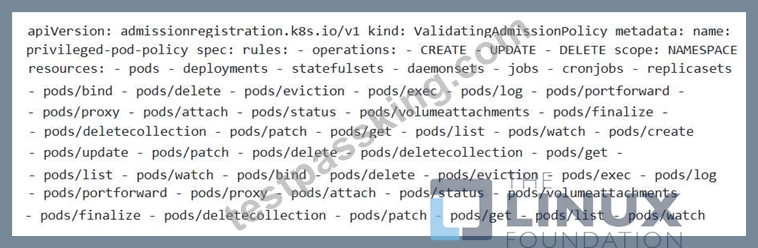
Answer: C
Explanation:
Option E is the most appropriate configuration for preventing pods from running with the '-privileged' flag. This configuration defines a ValidatingAdmissionPolicy named 'privileged-pod-policy' that specifically targets pod creation operations ('CREATE'). It checks the 'securityContext' field of the pod spec and ensures that the 'privileged' field is set to 'false". By enforcing this rule, the admission controller will block any attempt to create pods with the privileged" flag, enhancing the security of your Kubernetes cluster.
NEW QUESTION # 58
Explain the concept of "service discovery" in Prometheus and how it integrates with Kubernetes.
- A. Service discovery is not related to Kubernetes and is only used for external monitoring solutions.
- B. Service discovery allows Prometheus to automatically find and scrape metrics from target endpoints, making it easier to monitor dynamic Kubernetes environments.
- C. Service discovery is responsible for distributing Prometheus workloads across Kubernetes nodes for high availability.
- D. Service discovery is primarily used to manage Prometheus data storage and retention policies within Kubernetes clusters.
- E. Service discovery is a feature that enables Prometheus to create alerts based on changes in Kubernetes service configurations.
Answer: B
Explanation:
Service discovery in Prometheus enables it to locate and collect metrics from dynamic Kubernetes environments. It automatically discovers and configures scraping targets based on Kubernetes service definitions. This simplifies the monitoring process and ensures that Prometheus stays up-to-date with changes in the Kubernetes cluster.
NEW QUESTION # 59
Which CNCF project is the dominant project with respect to container registries
- A. Envoy
- B. Harbor
- C. Kubernetes
- D. Rook
Answer: B
Explanation:
https://goharbor.io/
NEW QUESTION # 60
Various Container Orchestrator Systems (COS)?
- A. Kubernetes
- B. None of the options
- C. Docker Swarm
- D. Apache Mesos
Answer: A,C,D
NEW QUESTION # 61
You're developing a new microservice for an application running on Kubernetes. The service requires access to a database hosted in a separate Kubernetes cluster. How would you ensure secure communication between your microservice and the database?
- A. Use a shared secret stored in an environment variable within the microservice pod
- B. Configure a service mesh to handle encryption and authentication between the services.
- C. Set up a VPN connection between the two Kubernetes clusters-
- D. Configure a Kubernetes Ingress resource to route traffic to the database
- E. Use an API gateway to proxy requests between the services.
Answer: B
Explanation:
A service mesh like Istio or Linkerd provides a layer of abstraction that can handle encryption, authentication, and authorization bewveen microservices within and across Kubernetes clusters. It allows for secure communication without exposing sensitive credentials directly within the microservice code.
NEW QUESTION # 62
Explain the difference between a Kubernetes Deployment and a ReplicaSet. When would you use each of these resources?
- A. ReplicaSet is a high-level resource that manages the lifecycle of Deployments, while Deployment is a low-level resource that manages a set of Pods with the same template.
- B. Deployment and ReplicaSet are interchangeable, and both manage the lifecycle of Pods with the same template.
- C. Deployment is a low-level resource that manages the lifecycle of ReplicaSets, while ReplicaSet is a high-level resource that manages a set of Pods with the same template.
- D. Deployment is a high-level resource that manages the lifecycle of ReplicaSets, while ReplicaSet is a low-level resource that manages a set of Pods with the same template.
- E. ReplicaSet is a low-level resource that manages the lifecycle of Deployments, while Deployment is a high-level resource that manages a set of Pods with the same template-
Answer: D
Explanation:
A Deployment is a high-level resource that manages the lifecycle of ReplicaSets. It defines the desired number of replicas, the pod template, and handles updates and rollbacks. A ReplicaSet is a low-level resource that manages a set of Pods with the same template. It ensures that the desired number of Pods are running based on the defined selector and ensures that pods are replaced when needed. You would use a Deployment for managing updates, rollbacks, and scaling of your applicatiom You would use a ReplicaSet if you only need to manage a set of Pods with the same template and don't require the features provided by a Deployment.
NEW QUESTION # 63
You are working on a cloud-native application that needs to interact with a database service. The application requires high availability and fault tolerance. Which open standard would you use to ensure reliable database connections and handle failures gracefully?
- A. Kubernetes Ingress
- B. CloudEvents
- C. OpenTelemetry
- D. Service Mesh
- E. OpenTracing
Answer: D
Explanation:
A Service Mesh is a crucial element in achieving high availability and fault tolerance for database connections. It provides features like load balancing, circuit breakers, and retries, which are essential for handling failures and ensuring the application remains operational even if a database instance becomes unavailable.
NEW QUESTION # 64
You are setting up Prometheus to monitor a Kubernetes cluster. You need to ensure that Prometheus can collect metrics from pods running different applications. Which Kubernetes object is typically used to configure Prometheus for scraping these pods?
- A. ConfigMap
- B. Service
- C. Deployment
- D. Secret
- E. pod
Answer: A
Explanation:
A ConfigMap is typically used to provide Prometheus with the necessary configuration for scraping pods. The ConfigMap can contain details such as scraping intervals, target labels, and authentication credentials. This configuration allows Prometheus to effectively monitor pods running different applications within the Kubernetes cluster.
NEW QUESTION # 65
You are implementing a GitOps workflow for a complex application with multiple microservices. To manage dependencies between these microservices and ensure their correct deployment order, which approach would be most suitable?
- A. Use a single Git repository for all microservices and leverage a GitOps tool like ArgoCD or Flux to manage dependencies with features like resource dependencies and deployment order.
- B. Use a Kubernetes Operator to automate the deployment and management of the microservices, ensuring their dependencies are met.
- C. Use a single Git repository for all microservices and define deployment dependencies using Helm charts.
- D. Use a separate Git repository for each microservice and manually coordinate their deployments.
- E. Use a separate Git repository for each microservice and configure a CIICD pipeline to manage their dependencies.
Answer: A
Explanation:
Option C provides the most suitable approach for managing dependencies between multiple microservices in a GitOps workflow. Using a single repository for all microservices and leveraging a GitOps tool like ArgoCD or Flux allows you to define resource dependencies and specify the deployment order for microservices, ensuring a consistent and predictable deployment process.
NEW QUESTION # 66
What are the key differences between a Kubernetes Pod and a Docker container? Provide examples of how they are used in a Kubernetes deployment.
- A. A Docker container is managed by Kubernetes, while a Pod is managed by Docker.
- B. A Pod is a single running container, while a Docker container can run multiple applications.
- C. A Pod is a logical grouping of one or more containers, while a Docker container is a single running instance of an image.
- D. A Pod is a cloud-native application, while a Docker container is a traditional application.
- E. A Pod is a physical machine, while a Docker container is a virtual machine.
Answer: C
Explanation:
A Pod in Kubernetes is the smallest deployable unit. It represents a group of one or more containers that share resources and networking. Docker containers, on the other hand, are individual running instances of Docker images. Examples: Pod: You could have a Pod that runs a web server container, a database container, and a logging container, all working together as a single unit. Kubernetes manages the scheduling, networking, and resource allocation for the entire Pod. Docker Container: You could run a single Docker container for a web server application on a single machine.
NEW QUESTION # 67
Explain the difference between a container image and a container runtime?
- A. A container runtime is a blueprint for creating a container, while a container image is the software that executes the container.
- B. A container runtime is a pre-built package of an application, while a container image is a virtual machine that runs the application.
- C. A container image is a pre-built package of an application, while a container runtime is a virtual machine that runs the application.
- D. A container image is a blueprint for creating a container, while a container runtime is the software that executes the container.
- E. Both container images and container runtimes are the same thing, just different names.
Answer: D
Explanation:
A container image is a blueprint for creating a container, while a container runtime is the software that executes the container. A container image contains all the necessary components, libraries, and dependencies to run an application in a container. It's a snapshot of a specific point in time. Container runtimes, such as Docker, containerd, or CRI-O, are responsible for loading the image, creating a container, and managing its lifecycle. They provide the environment and resources for the container to run.
NEW QUESTION # 68
You need to create a Kubernetes service that exposes a TCP-based application on port 8080. You want the service to be accessible from external clients. Which type of service should you create?
- A. ClusteriP
- B. NodePort
- C. LoadBalancer
- D. ExternalName
- E. Headless
Answer: C
Explanation:
The *LoadBalancer• service type is the most suitable for exposing your TCP-based application on port 8080 to external clients. It will automatically create a load balancer in the cloud provider's infrastructure, allowing external access to your application. Option 'A' (ClusterlP) only allows access from within the cluster. Option 'C' (NodePort) exposes the service on a specific port on each node, making it accessible via the node's IP address. Option 'D' (ExternalName) is for exposing services that are already externally accessible using a DNS name. Option 'E' (Headless) is for services where you want to access Pods directly by their names, which is not the case here.
NEW QUESTION # 69
......
Download Latest & Valid Questions For Linux Foundation KCNA exam: https://www.testpassking.com/KCNA-exam-testking-pass.html
Exam Dumps for the Preparation of Latest KCNA Exam Questions: https://drive.google.com/open?id=1PqrEG3VYGejYSUvUfqQEWcEefHxHPJ71