

Updated Jun-2026 Pass ACD201 Exam - Real Practice Test Questions
Download Free Appian ACD201 Real Exam Questions
NEW QUESTION # 43
You need to select a plug-in to meet a specific requirement and several plug-ins can do the job.
What are three key factors to consider? (Choose three.)
- A. Is the plug-in open source or proprietary?
- B. What is the size of the plug-in?
- C. What are the compatible Appian versions?
- D. Is the plug-in approved for use in the Cloud?
- E. Who is the creator of the plug-in?
- F. What are the limitations of the plug-in?
Answer: C,D,F
Explanation:
Limitations of the plug-in help you understand constraints or potential issues that could impact your implementation.
Compatible Appian versions ensure the plug-in will work correctly in your current and future environments.
Cloud approval status is essential for Appian Cloud environments, as only approved plug-ins are permitted for deployment.
NEW QUESTION # 44
You're creating a support case record type while working on a support case management system. You want to track support case status changes.
You want to use record events to track this information.
Which record data source type is the most appropriate for you to use?
- A. Process Model source with data sync enabled
- B. Database source with data sync enabled
- C. Web service without data sync enabled
Answer: B
Explanation:
A database source with data sync enabled is required to use record events for tracking support case status changes, as Appian record events are only supported for synced record types with a database as the data source.
NEW QUESTION # 45
Your client reported that a form in the application is very slow to load.
You investigate and find a query entity which is nor performing well.
Which action should you perform to improve query performance for the query entity?
- A. Apply the appropriate filters and indices in both Appian and the database.
- B. Apply indices on all the fields referred in the query.
- C. Change the data source of the query entity to a view with a WHERE clause.
Answer: A
Explanation:
Applying appropriate filters and indices in both Appian and the database ensures that only relevant data is retrieved and the database query runs efficiently, improving overall query performance.
NEW QUESTION # 46
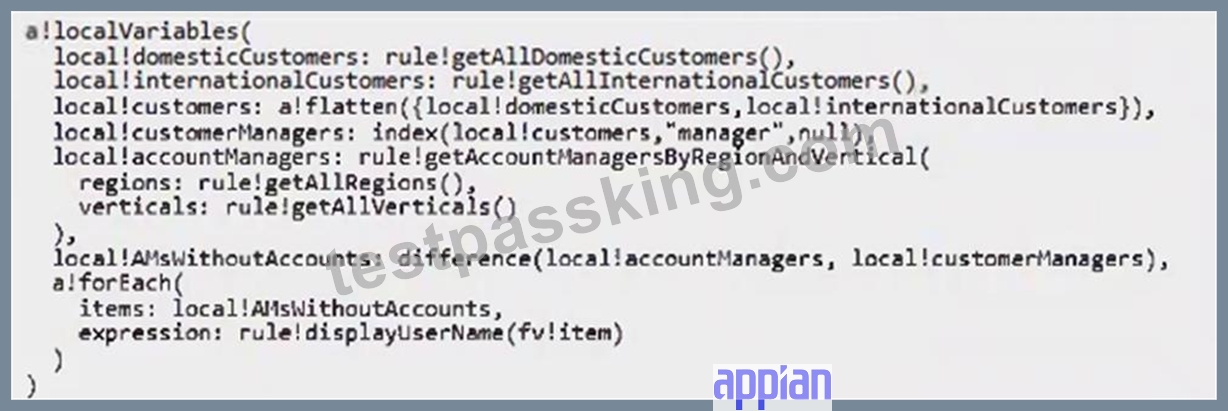
You need to write an expression to retrieve a list of all account managers who don't currently have an active customer account.
Which code snippet should you use?
- A.

- B.
- C.
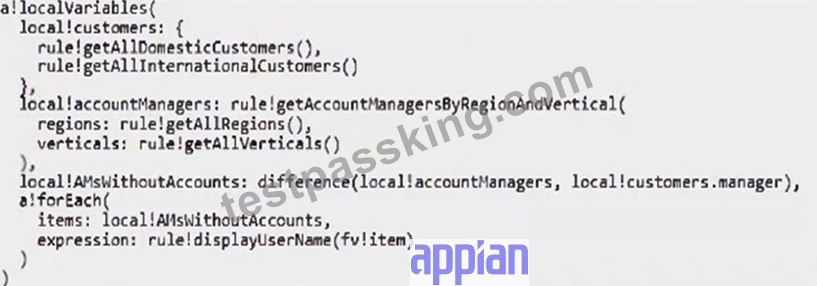
Answer: C
Explanation:
Chosen snippet uses the difference() function to efficiently get all account managers who are not currently managers of any customer account. It directly compares local!accountManagers to local!customers.manager, resulting in a concise and optimal solution for retrieving account managers without an active customer account.
NEW QUESTION # 47
You're building a new application to track job applications for a local health club.
The owner wants to have one group of individuals perform the initial application review for completeness, a second group to manage the interview process, and a third group to make the actual hiring decisions.
Which design element should be implemented to best support a memory efficient application?
- A. Create a synchronous process that accurately tracks a candidate's application from start to finish to ensure the hiring group has access to all the information necessary to make a decision.
- B. Create an entity-backed record for each of the open positions.
- C. Break up the application into subprocesses representing each of the different stages of the process to reduce memory use.
Answer: C
Explanation:
Breaking up the application into subprocesses for each stage allows each part to be short-lived and releases memory as each subprocess completes, resulting in a more memory-efficient application.
NEW QUESTION # 48
An insurance company's product details are currently distributed across numerous database tables, encompassing over 60 to 70 fields.
You need to implement a product comparison tool for business users to compare up to three insurance products simultaneously, with all the product details in a tabular format.
Refer to the following sample format: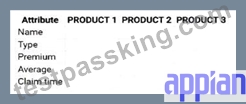
Which object should be used to transform the data into the required format?
- A. Record type with relationships
- B. Stored procedure
- C. VCCCiews
Answer: C
Explanation:
Database views are ideal for transforming complex, distributed product data into a single, flattened structure tailored for reporting or comparison. In this case, a view can pivot the 60-70 fields and organize them by attribute (e.g., Name, Type, Premium) across multiple product columns, enabling a tabular comparison layout like the one shown. Views also optimize performance and reduce transformation overhead in the interface layer.
NEW QUESTION # 49
You're conducting a design review.
You identify slow-performing expression rules querying a specific data store, and need to understand the
"number of operations against data stores."
Which metric from the data_store_details.csv file is helpful to you?
- A. Execute Count
- B. Query Count
- C. TCCCotal Count
Answer: B
Explanation:
The "Query Count" metric in the data_store_details.csv file indicates the number of operations (queries) performed against data stores, helping you analyze data store usage.
NEW QUESTION # 50
An energy company wants to allow the public to be able to report power outages directly and provide supporting documentation in the form of photos and/or videos. The company also requires the reporter's contact details.
How can a developer design and implement this requirement in Appian?
- A. A site where the user can trigger a process that captures the information including any uploaded files, and uploads everything to an internal Microsoft SharePoint site.
- B. A portal that interacts with records that stores the name, address, contact information, with a defined folder to store uploaded documents.
- C. A custom version of the Appian mobile app that the user can use to capture details, attached photos, and upload documents.
Answer: B
Explanation:
A portal interacting with records can capture public outage reports, contact details, and upload supporting documents to a defined folder, making the process accessible to the public without requiring authentication.
NEW QUESTION # 51
You need to test a related action that updates record data.
Appropriate users must be able to access the form. You also need to ensure that the data is successfully updated.
Using Appian, which is the best testing method you should use?
- A. Performance Testing
- B. Unit Testing
- C. User Accepting Testing
Answer: C
Explanation:
User Acceptance Testing (UAT) is the best method, as it ensures appropriate users can access the form and verifies that the data update process works as intended in a real-world scenario.
NEW QUESTION # 52
You're creating a point-of-sale (POS) system for a customer which can associate the items in a transaction to a customer based on a membership number. The item stock table and the customer sales record are hosted elsewhere and need to be written to via POST APIs from an Appian process model. This all occurs within a transaction process model that you're creating.
Which two steps should you perform to design your process model to improve process memory? (Choose two.)
- A. Ensure that the entire process is activity-chained so that the person entering the transaction knows when the process is completed.
- B. Create the two POST APIs as synchronous subprocesses.
- C. Create the two POST APIs as asynchronous subprocesses.
- D. Add a terminate process node to the end of the process.
Answer: C,D
Explanation:
Creating the POST API calls as asynchronous subprocesses allows them to run independently, reducing memory usage in the main process.
Adding a terminate process node at the end ensures the process completes and releases memory as soon as its work is finished.
NEW QUESTION # 53
You're configuring Health Check settings under the Admin Console.
Which section would you find the setting to indicate that the Health Check will run on a Production Environment?
- A. General
- B. Scheduling
- C. Automatic Upload
Answer: C
Explanation:
The Automatic Upload section in the Health Check settings of the Admin Console includes the option to indicate that the Health Check is running on a Production Environment, which helps Appian appropriately analyze and benchmark the data.
NEW QUESTION # 54
You need to create an expression rule that will be reused throughout your environment.
What are two reasons why you should include meaningful test cases when creating a new expression rule? (Choose two.)
- A. To improve the performance of the environment.
- B. To enhance the appearance of the code.
- C. To accelerate various types of testing, including: unit, regression, exploratory.
- D. To facilitate Test-Driven Development.
Answer: C,D
Explanation:
Meaningful test cases accelerate different testing types by providing clear validation scenarios for the rule.
They support Test-Driven Development by enabling you to define expected outcomes before or during rule creation.
NEW QUESTION # 55
You need to implement a requirement where a third-party system starts a process in Appian. The third-party system can invoke a service only through Web Services Description Language (WSDL).
What should you do to start the process in Appian?
- A. Create a custom plug-in.
- B. Create a default WSDL URL using process model UUID.
- C. Expose process model as a web service.
Answer: C
NEW QUESTION # 56
You need to configure your process model to store the result of an expression rule for every item in a list. Your design must have the smallest memory footprint.
What should you do?
- A. Create a loop of smart service nodes in the process model and execute it for each item in the list.
- B. Execute MNI over a script task for each item in the list.
- C. Configure a script task to use a!forEach() to iterate over each item in the list.
- D. Invoke a sub-process for each item in the list.
Answer: C
Explanation:
Configuring a script task to use a!forEach() to iterate over each item in the list allows you to process all items within a single task, minimizing the memory footprint compared to multiple subprocesses or smart service loops.
NEW QUESTION # 57
You need to create a new database schema using a connected data source system.
What should you do?
Note: To answer, move all steps from the Options list to the Answer List area and arrange them in the correct order.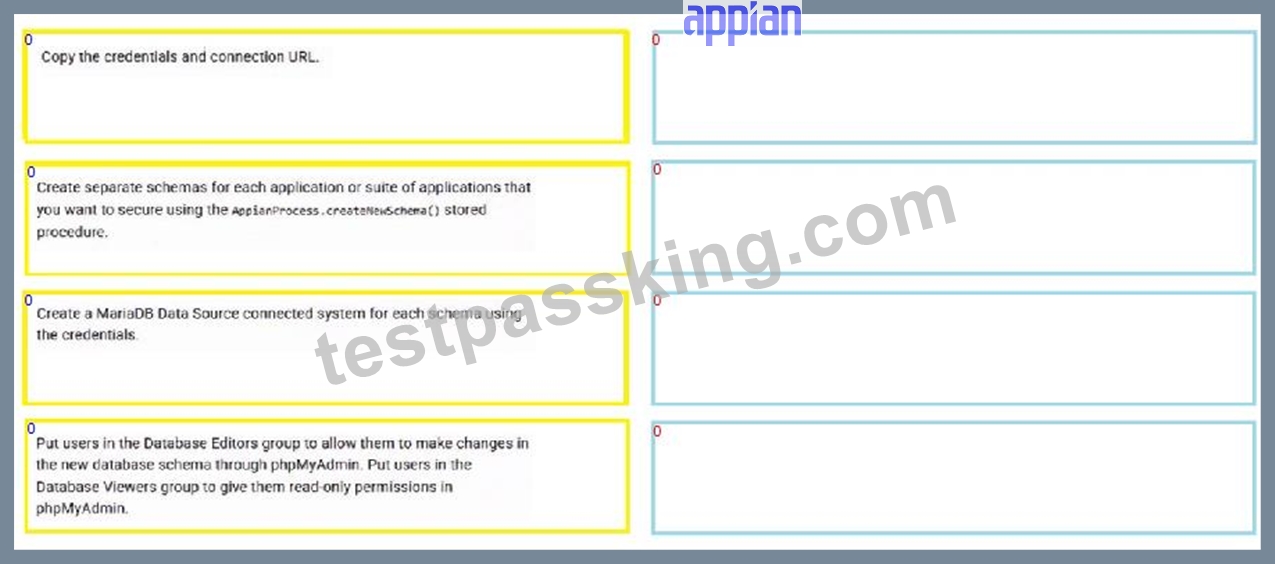
Answer:
Explanation: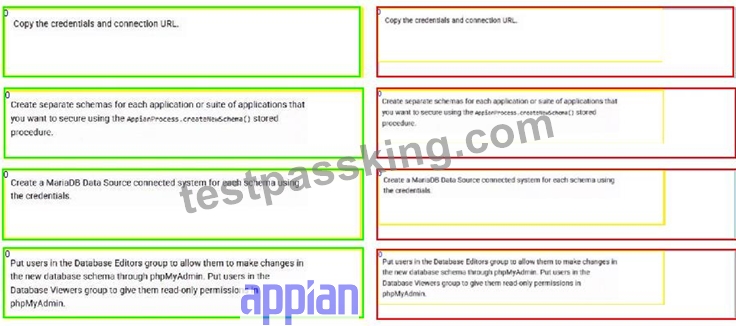
NEW QUESTION # 58
How can a user in the Appian environment prevent the uploading of documents without extensions?
- A. Restrict document uploads by user roles.
- B. No actions are required from the user; Appian auto validates these documents.
- C. Enable File upload > Block files without an extension, under the Administrative console.
Answer: C
NEW QUESTION # 59
A seamless user experience (UX) is important for an application so that a user does not feel like they are moving through different applications. Often when many developers are working on the same project all together, this can be a concern.
How should you ensure that a seamless UX is maintained throughout the app?
- A. Create and add reusable interface components to the Design Library so that developers can quickly and easily use reusable interfaces.
- B. Create reusable expression rules to ensure that the same rules are being used throughout.
- C. Allow each developer to copy client provided mock-ups individually.
Answer: A
Explanation:
Creating and adding reusable interface components to the Design Library ensures consistency in look and feel across the application, allowing all developers to easily implement a seamless user experience.
NEW QUESTION # 60
Which two options are correct regarding record relationships when using synced records in your application? (Choose two.)
- A. Up to 20 relationships can be added on a record type with data sync enabled.
- B. Many-to-one relationships can be established using record relationships.
- C. Record type relationships enforce referential integrity.
- D. Relationships can be established between any record types that have sync enabled, regardless of the source.
Answer: A,B
Explanation:
Many-to-one relationships can be established between record types using record relationships.
Up to 20 relationships can be added to a record type with data sync enabled, according to Appian platform limits.
NEW QUESTION # 61
Match each authentication type to the correct authentication characteristic description.
Note: Each description will be used once. To change your responses, you may deselect your response by clicking the blank space at the top of the selection list.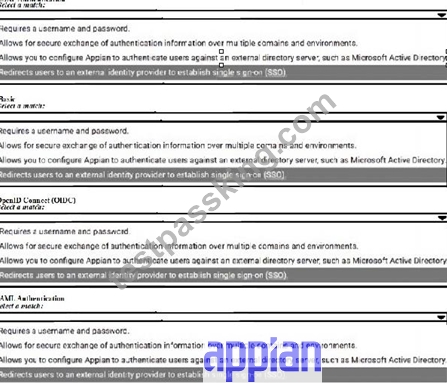
Answer:
Explanation: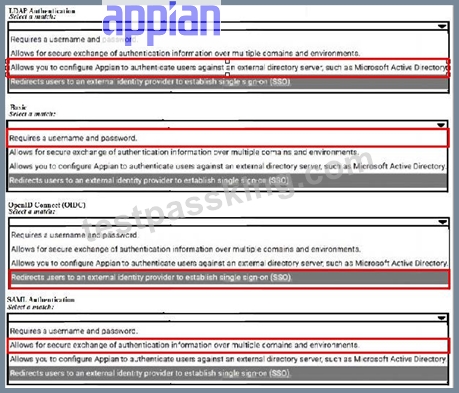
NEW QUESTION # 62
You're making a POST request to the Appian web API. You need to include complex data structures, such as lists or objects, in the request body.
How should you design the API to accept those requests?
- A. Use query parameters to represent the complex data structures.
- B. Use XML format to represent the complex data structures in the request body.
- C. Convert the complex data structures to JSON and include them in the request body as a string.
Answer: C
Explanation:
To include complex data structures like lists or objects in a POST request to an Appian Web API, you should convert the data to JSON and include it in the request body as a string. Appian supports application/json content type for parsing complex data structures in APIs.
NEW QUESTION # 63
The synced record Task has a self-referential relationship defined in the column parentTaskId. There is a many-to- one record relationship between the id and parentTaskId called parentTask.
For a given task ID, you need to return the task name and the parent task name.
What should you do?
- A. Use a!queryRecordType() filtered on the task id once to return the task name and parent task ID. Query the record again to return the parent task name.
- B. Create a sync-time custom record field on the Task record called parentName. Specify this field to return in the query field selection.
- C. Use a!queryRecordType() With a filter on the task id, with fields specified to return recordType!Task.name and recordType!Task.parentTask.name.
Answer: C
Explanation:
A single a!queryRecordType() call filtered by the task's id and selecting both recordType!Task.name and recordType!Task.parentTask.name leverages the existing self-referential relationship, returning the task name and its parent's name in one efficient query without additional custom fields or extra queries.
NEW QUESTION # 64
You run a report on different employee transactions by using a View.
You encounter the following error: "a!queryEntity: An error occurred while retrieving the data." What is the most likely root cause of this error?
- A. The rule contains a missing syntax.
- B. The view doesn't have a column mapped as a primary key in its corresponding CDT.
- C. The view contains a large number of rows, requiring more time to fetch the data.
Answer: B
Explanation:
The most likely root cause is that the view doesn't have a column mapped as a primary key in its corresponding CDT. Appian requires a primary key mapping for querying views to ensure data integrity and identification.
NEW QUESTION # 65
......
Appian ACD201 Exam Syllabus Topics:
| Topic | Details |
|---|---|
| Topic 1 |
|
| Topic 2 |
|
| Topic 3 |
|
| Topic 4 |
|
ACD201 Dumps 100 Pass Guarantee With Latest Demo: https://www.testpassking.com/ACD201-exam-testking-pass.html
Pass Your Exam With 100% Verified ACD201 Exam Questions: https://drive.google.com/open?id=1ZBYM9fj9ck-KYC9I0yZJjVXxZamPXX-1