

Latest [Oct 12, 2021] AZ-104 Exam with Accurate Microsoft Azure Administrator PDF Questions
Take a Leap Forward in Your Career by Earning Microsoft 455 Questions
NEW QUESTION 108
You sign up for Azure Active Directory (Azure AD) Premium.
You need to add a user named [email protected] as an administrator on all the computers that will be joined to the Azure AD domain.
What should you configure in Azure AD?
- A. Providers from the MFA Server blade.
- B. User settings from the Users blade.
- C. General settings from the Groups blade.
- D. Device settings from the Devices blade.
Answer: D
Explanation:
Explanation
When you connect a Windows device with Azure AD using an Azure AD join, Azure AD adds the following security principles to the local administrators group on the device:
The Azure AD global administrator role
The Azure AD device administrator role
The user performing the Azure AD join
In the Azure portal, you can manage the device administrator role on the Devices page. To open the Devices page:
1. Sign in to your Azure portal as a global administrator or device administrator.
2. On the left navbar, click Azure Active Directory.
3. In the Manage section, click Devices.
4. On the Devices page, click Device settings.
5. To modify the device administrator role, configure Additional local administrators on Azure AD joined devices.
References: https://docs.microsoft.com/en-us/azure/active-directory/devices/assign-local-admin
NEW QUESTION 109
You plan to create the Azure web apps shown in the following table.
What is the minimum number of App Service plans you should create for the web apps?
- A. 0
- B. 1
- C. 2
- D. 3
Answer: C
Explanation:
Explanation
NET Core -> window/linux ASP .NET -> window PHP -> window/linux Ruby ->Linux
NEW QUESTION 110
You have an Azure subscription that contains the resources shown in the following table.
VM1 and VM2 run a website that is configured as shown in the following table.
LB1 is configured to balance requests to VM1 and VM2.
You configure a health probe as shown in the exhibit. (Click the Exhibit tab.)
You need to ensure that the health probe functions correctly.
What should you do?
- A. On LB1, change the port to 8080.
- B. On LB1, change the Unhealthy threshold to 65536.
- C. On VM1 and VM2, create a file named Probe1.htm in the C:\intepub\wwwroot\SiteA\Temp folder.
- D. On VM1 and VM2, create a file named Probe1.htm in the C:\intepub\wwwroot\Temp folder.
Answer: C
Explanation:
Load balancing provides a higher level of availability and scale by spreading incoming requests across virtual machines (VMs). You can use the Azure portal to create a Standard load balancer and balance internal traffic among VMs.
To load balance successfully between VM1 and VM2 you have to place the html file in the path mentioned in the Probe1 configuration.
References:
https://docs.microsoft.com/en-us/azure/load-balancer/tutorial-load-balancer-standard-internal-portal
NEW QUESTION 111
You have an Azure subscription that contains the resources shown in the following table.
VMSS1 is set to VM (virtual machines) orchestration mode.
You need to deploy a new Azure virtual machine named VM1, and then add VM1 to VMSS1.
Which resource group and location should you use to deploy VM1? To answer, select the appropriate options in the
NOTE: Each correct selection is worth one point.
Answer:
Explanation:
NEW QUESTION 112
You have an Azure subscription that contains the resources shown in the following table.
You need to deploy Application1 to Cluster1.
Which command should you run?
- A. az acr build
- B. kubectl apply
- C. az aks create
- D. docker build
Answer: A
NEW QUESTION 113
You have the Azure virtual machines shown in the following table.
VNNET1 is linked to a private DNS zone named contoso.com that contains the records shown in the following table.
Which DNS names can you use to ping VM2?
- A. comp1.contoso.com and comp2.contoso.com only
- B. comp1.contoso.com, comp2.contoso.com, and comp4.contoso.com only
- C. comp2.contoso.com and comp4.contoso.com only
- D. comp2.contoso.cam only
- E. comp1.contoso.com, comp2.contoso.com, comp3.contoso.com, and comp4.contoso.com
Answer: E
Explanation:
Reference:
https://medium.com/azure-architects/exploring-azure-private-dns-be65de08f780
https://simpledns.plus/help/dns-record-types
NEW QUESTION 114
You have an Azure subscription.
You create the Azure Storage account shown in the following exhibit.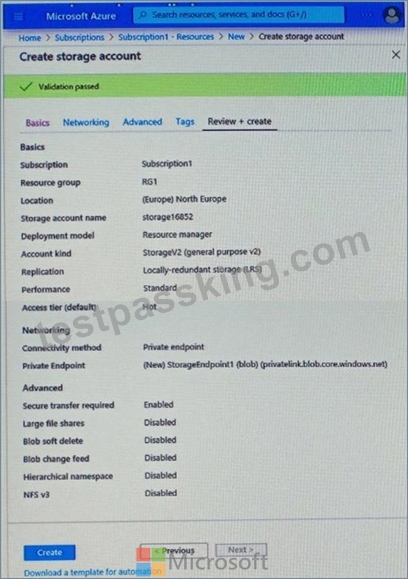
Use the drop-down menus to select the answer choice that completes each statement based on the information presented in the graphic.
NOTE: Each correct selection is worth one point.
Answer:
Explanation:
Explanation:
Box1: LRS will keep minimum three copies.
Box2: Changing the access tier from hot to cool will reduce the cost. In performance, standard is cheap.
In the Account kind, GPV2 is giving best price. Can be checked yourself using the pricing calculator on below link.
Reference:
https://azure.microsoft.com/en-in/pricing/calculator/?service=storage
NEW QUESTION 115
You have an Azure Service Bus.
You create a queue named Queue1. Queue1 is configured as shown in the following exhibit.
Use the drop-down menus to select the answer choice that completes each statement based on the information presented in the graphic.
NOTE: Each correct selection is worth one point.
Answer:
Explanation:
Reference:
https://docs.microsoft.com/en-us/azure/service-bus-messaging/message-expiration
https://docs.microsoft.com/en-us/azure/service-bus-messaging/message-transfers-locks-settlement
NEW QUESTION 116
You have an Azure subscription that contains a virtual network named VNET1 in the East US 2 region. You have the following resources in an Azure Resource Manager template.


For each of the following statements, select Yes if the statement is true. Otherwise, select No.
Answer:
Explanation:
Explanation
Box 1: Yes
Box 2: Yes
VM1 is in Zone1, while VM2 is on Zone2.
Box 3: No
Reference:
https://docs.microsoft.com/en-us/azure/architecture/resiliency/recovery-loss-azure-region
NEW QUESTION 117
You have an on-premises server that contains a folder named D:\Folder1.
You need to copy the contents of D:\Folder1 to the public container in an Azure Storage account named contosodata.
Which command should you run?
https://contosodata.blob.core.windows.net/public
- A. snapshot
azcopy copy D:\folder1 https://contosodata.blob.core.windows.net/public -- - B. azcopy sync D:\folder1 https://contosodata.blob.core.windows.net/public --
- C. recursive
az storage blob copy start-batch D:\Folder1 https:// - D. contosodata.blob.core.windows.net/public
Answer: C
Explanation:
Section: [none]
Explanation:
The azcopy copy command copies a directory (and all of the files in that directory) to a blob container. The result is a directory in the container by the same name.
Incorrect Answers:
B: The azcopy sync command replicates the source location to the destination location. However, the file is skipped if the last modified time in the destination is more recent.
D: The az storage blob copy start-batch command copies multiple blobs to a blob container.
Reference:
https://docs.microsoft.com/en-us/azure/storage/common/storage-use-azcopy-blobs
https://docs.microsoft.com/en-us/azure/storage/common/storage-ref-azcopy-copy
NEW QUESTION 118
You need to implement a backup solution for App1 after the application is moved.
What should you create first?
- A. a recovery plan
- B. a backup policy
- C. a Recovery Services vault
- D. an Azure Backup Server
Answer: C
Explanation:
A Recovery Services vault is a logical container that stores the backup data for each protected resource, such as Azure VMs. When the backup job for a protected resource runs, it creates a recovery point inside the Recovery Services vault.
Scenario:
There are three application tiers, each with five virtual machines.
Move all the virtual machines for App1 to Azure.
Ensure that all the virtual machines for App1 are protected by backups.
References: https://docs.microsoft.com/en-us/azure/backup/quick-backup-vm-portal
NEW QUESTION 119
You plan to create an Azure Storage account in the Azure region of East US 2.
You need to create a storage account that meets the following requirements:
* Replicates synchronously
* Remains available if a single data center in the region fails
How should you configure the storage account? To answer, select the appropriate options in the answer area.
NOTE: Each correct selection is worth one point.
Answer:
Explanation:
Explanation
Box 1: Zone-redundant storage (ZRS)
Zone-redundant storage (ZRS) replicates your data synchronously across three storage clusters in a single region.
LRS would not remain available if a data center in the region fails
GRS and RA GRS use asynchronous replication.
Box 2: StorageV2 (general purpose V2)
ZRS only support GPv2.
References:
https://docs.microsoft.com/en-us/azure/storage/common/storage-redundancy
https://docs.microsoft.com/en-us/azure/storage/common/storage-redundancy-zrs
NEW QUESTION 120
You need to resolve the licensing issue before you attempt to assign the license again.
What should you do?
- A. From the Directory role blade, modify the directory role.
- B. From the Profile blade, modify the usage location.
- C. From the Groups blade, invite the user accounts to a new group.
Answer: C
Explanation:
License cannot be assigned to a user without a usage location specified.
Scenario: Licensing Issue
You attempt to assign a license in Azure to several users and receive the following error message: "Licenses not assigned. License agreement failed for one user." You verify that the Azure subscription has the available licenses.
NEW QUESTION 121
VM1 is running and connects to NIC1 and Disk1. NIC1 connects to VNET1.
RG2 contains a public IP address named IP2 that is in the East US location. IP2 is not assigned to a virtual machine.
For each of the following statements, select Yes if the statement is true. Otherwise, select No.
NOTE: Each correct selection is worth one point.
Answer:
Explanation:
Reference:
https://docs.microsoft.com/en-us/azure/azure-resource-manager/management/move-support-resources
https://docs.microsoft.com/en-us/azure/virtual-network/move-across-regions-publicip-powershell
NEW QUESTION 122
You have an Azure subscription that contains a resource group named RG26.
RG26 is sot to the West Europe location and is used to create temporary resources for a project. RG26 contains the resources shown in the following table.
SQLD01 is backed up to RGV1.
When the project is complete, you attempt to delete RG26 from the Azure portal. The deletion fails.
You need to delete RG26.
What should you do first?
- A. Delete sa001.
- B. Delete VM1.
- C. Stop the backup of SQLDB01.
- D. StopVM1.
Answer: C
Explanation:
Explanation
You can't delete a vault that contains backup data. So in this case at first you have to delete the backup of
'SQLD01' before you attempt to delete the vault.
Reference:
https://docs.microsoft.com/en-us/azure/backup/backup-azure-delete-vault
NEW QUESTION 123
You purchase a new Azure subscription named Subscription1.
You create a virtual machine named VM1 in Subscription1. VM1 is not protected by Azure Backup.
You need to protect VM1 by using Azure Backup. Backups must be created at 01:00 and stored for 30 days.
What should you do? To answer, select the appropriate options in the answer area.
NOTE: Each correct selection is worth one point.
Answer:
Explanation:
References:
https://docs.microsoft.com/en-us/azure/backup/backup-azure-recovery-services-vault-overview https://docs.microsoft.com/en-us/azure/backup/backup-azure-vms-first-look-arm
https://docs.microsoft.com/en-us/azure/backup/backup-azure-recovery-services-vault-overview https://docs.microsoft.com/en-us/azure/backup/backup-azure-vms-first-look-arm
NEW QUESTION 124
Note: This question is part of a series of questions that present the same scenario. Each question in the series contains a unique solution that might meet the stated goals. Some question sets might have more than one correct solution, while others might not have a correct solution.
After you answer a question in this section, you will NOT be able to return to it. As a result, these questions will not appear in the review screen.
You have an Azure subscription that contains the virtual machines shown in the following table.
You deploy a load balancer that has the following configurations:
Name: LB1
Type: Internal
SKU: Standard
Virtual network: VNET1
You need to ensure that you can add VM1 and VM2 to the backend pool of LB1.
Solution: You create a Standard SKU public IP address, associate the address to the network interface of VM1, and then stop VM2.
Does this meet the goal?
- A. No
- B. Yes
Answer: A
Explanation:
A Backend Pool configured by IP address has the following limitations:
Standard load balancer only
Reference:
https://docs.microsoft.com/en-us/azure/load-balancer/backend-pool-management
NEW QUESTION 125
You create a Recovery Services vault backup policy named Policy1 as shown in the following exhibit:

Use the drop-down menus to select the answer choice that completes each statement based on the information presented in the graphic.
NOTE: Each correct selection is worth one point.
Answer:
Explanation:
Explanation:
Box 1: 10 years
The yearly backup point occurs to 1 March and its retention period is 10 years.
Box 2: 36 months
The monthly backup point occurs on the 1st of every month and its retention period is 36 months.
NEW QUESTION 126
......
Authentic Best resources for AZ-104 Online Practice Exam: https://www.testpassking.com/AZ-104-exam-testking-pass.html
Practice To AZ-104 - TestPassKing Remarkable Practice On your Microsoft Azure Administrator Exam: https://drive.google.com/open?id=1Kq70U3Z5vBM8-jXv48k2iU6b3XazNSt0