

HPE7-V01 Braindumps PDF, HP HPE7-V01 Exam Cram
New 2026 HPE7-V01 Sample Questions Reliable HPE7-V01 Test Engine
NEW QUESTION # 23
Your customer would like to improve the security of an existing physical and virtual environment. They are currently using the Synergy environment with the first generation of HPE Composer and Gen9 Synergy compute modules.
Which of the following changes would improve security?
- A. Implement the HPE OneView Global Dashboard that can be used to distribute encryption keys and CA- signed certificates to all managed nodes.
- B. Update the iLO firmware in the Gen9 Synergy compute modules to benefit from the Silicon Root of Trust.
- C. Replace the Gen9 compute modules with Gen11, including HPE iLO, that provides the Silicon Root of Trust.
- D. Add dedicated HPE OneView licenses to enable integration with Active Directory to provide extensive permission control within a physical environment.
Answer: C
Explanation:
The correct answer is C. The customer is using older Gen9 Synergy compute modules, and the required improvement is hardware-rooted platform security. Silicon Root of Trust is an HPE firmware security capability anchored in server hardware and iLO, designed to validate firmware before boot and protect the platform from compromised firmware. HPE states that Gen10 servers introduced Silicon Root of Trust, and Gen11 systems continue that trusted-security model with enhanced iLO capabilities. Option A is incorrect because a firmware update cannot retrofit Silicon Root of Trust into Gen9 hardware that lacks the required silicon foundation. Option B misrepresents HPE OneView Global Dashboard; it provides aggregated management visibility, not centralized distribution of encryption keys and CA- signed certificates to all nodes. Option D can improve administrative integration and role control, but it does not address the deeper platform-trust gap created by the older compute generation. Reference
/topics: HPE security architecture, Silicon Root of Trust, iLO security, Synergy Gen9-to-Gen11 modernization, hybrid-infrastructure protection.
NEW QUESTION # 24
Your customer is requesting an update to their data protection plan, to include a copy of several volumes to two different locations. The current environment is utilizing HPE Alletra Storage MP B10000 systems.
What is true about this solution?
- A. Synchronous replication can be configured between three arrays.
- B. A synchronous long-distance periodic copy configuration can be used to define two destination targets.
- C. Synchronous replication can be used to define two destination targets, when appropriate license is installed.
- D. Asynchronous replication can be configured between three arrays.
Answer: B
Explanation:
The correct answer is D. When a customer needs copies of protected volumes in two different locations, the design moves beyond a simple two-array synchronous replication pair. HPE Alletra Storage MP B10000 uses Remote Copy concepts that include synchronous replication for zero-data-loss protection and three-data-center designs where synchronous and asynchronous relationships are combined. In a synchronous long-distance periodic copy configuration, one target is used for synchronous protection and another target is used for periodic/asynchronous protection, giving the customer two destination locations with different recovery characteristics. HPE guidance for three-data-center Peer Persistence
/Remote Copy designs describes adding two replication configurations: one for the synchronous target and one for the asynchronous target. Option A is incorrect because pure synchronous replication does not simply fan out to two synchronous targets. Option B is incorrect because synchronous replication is fundamentally a paired active/synchronous relationship, not a generic three-array synchronous mesh.
Option C is too broad and does not meet the specific high-availability design implied by the question.
Reference/topics: HPE Remote Copy, synchronous long-distance replication, three-data-center protection, B10000 data-protection architecture.
NEW QUESTION # 25
You are designing a solution for a customer that will support a virtualization workload based on HPE Synergy. Your customer has the following requirements:
* Dual-socket HPE Synergy compute nodes running ESXi 8.x with maximum memory supported
* Each node should have access to shared storage from HPE Alletra Storage MP B10000
* All virtual machines should be protected against host failure
* All virtual machines with vGPU must be protected with Fault Tolerance
* All compute nodes should boot from disks located in the D3940 Storage Modules protected with RAID
1
* All frames should be managed as one logical enclosure to simplify management
* All compute nodes should support two network ports with the maximum Ethernet connectivity speed You are reviewing a proposal that you must verify. The proposal consists of:
* 3 x HPE Synergy 12000 frames
* 2 x HPE Synergy Composer2 modules
* 4 x HPE Virtual Connect SE 100Gb F32 Modules for Synergy
* 4 x HPE Synergy 50Gb Interconnect Link Modules
* 3 x HPE Synergy D3940 Storage Modules, each with 20 SSD drives
* 1152 core VMware vSphere Enterprise Plus subscriptions
* 36 x HPE Synergy 480 Gen11 compute nodes
Each SY480 Gen11 is configured with:
* A single Platinum CPU with 32 cores
* HPE Synergy 6820C 25/50Gb Converged Network Adapter
* HPE Synergy 5830C 32Gb Fibre Channel Host Bus Adapter
* HPE MR416i-o Gen11 12G SAS Mezzanine Controller
Which two statements are true regarding the proposal? (Select two.)
- A. vSphere Enterprise Plus subscriptions can be replaced with vSphere Standard subscriptions.
- B. 2 HPE Synergy 50Gb Interconnect Link Modules should be removed from the proposal, as the total number of interconnects required is six.
- C. HPE MR416i-o Smart RAID controller can be removed because there are no external SAS disk enclosures included in the proposal.
- D. To access HPE Alletra MP B10000 arrays, FC upgrade licenses for HPE Virtual Connect SE 100Gb F32 Modules for Synergy must be purchased.
- E. Two HPE Virtual Connect SE 100Gb F32 Modules for Synergy can be removed from the proposal because all requirements are met without them.
Answer: D,E
Explanation:
The correct answers are C and D. In a three-frame HPE Synergy design using the primary/satellite fabric model, a redundant pair of HPE Virtual Connect SE 100Gb F32 modules can provide the intelligent fabric function while Interconnect Link Modules extend connectivity to satellite frames.
Therefore, the proposal can be reduced by removing two unnecessary F32 modules if the remaining pair and link modules still satisfy the required redundant 25/50Gb connectivity. HPE describes the F32 architecture as consolidating data center network connections and scaling bandwidth across multiple Synergy frames using a primary/satellite design. Option D is also correct because Fibre Channel uplink functionality on the HPE Virtual Connect SE 100Gb F32 requires a separate Synergy 32Gb FC upgrade license. HPE OneView documentation states that the Synergy 32Gb FC Upgrade license is required for this interconnect to use Fibre Channel uplinks. Option B is false because the D3940 boot design still needs the SAS/RAID path. Option E is false because Fault Tolerance and advanced availability requirements make Standard an unsafe downgrade. Reference/topics: Synergy fabric validation, F32 FC licensing, D3940 boot architecture, VMware licensing review.
NEW QUESTION # 26
Your customer is in the early stages of an AI project. They are requesting a POC demonstrating how they can utilize on-prem data with a limited amount of rack space, in an air-cooled environment.
Performance with the AI use case of Retrieval-Augmented Generation (RAG) will be the primary factor in their decision making.
Which HPE Compute offering would be suitable in this scenario?
- A. HPE ProLiant Compute DL320 Gen11 with NVIDIA L4 GPUs.
- B. HPE Cray XD670 with NVIDIA H200 Tensor Core GPUs.
- C. HPE ProLiant Compute DL384 Gen12 with NVIDIA GH200 NVL2.
- D. HPE ProLiant Compute DL560a Gen12 with NVIDIA H200 NVL GPUs.
Answer: A
Explanation:
The correct answer is C because the customer's requirement is for an early-stage AI proof of concept, on-prem data usage, limited rack space, and an air-cooled environment. HPE ProLiant DL320 Gen11 with NVIDIA L4 GPUs is a compact, rack-efficient platform suitable for AI inference and edge-style workloads. HPE describes the DL320 Gen11 as a compact 1U platform that can support up to four NVIDIA L4 Tensor Core GPUs, making it appropriate for space-constrained AI inferencing and near- real-time insight use cases. RAG workloads often need strong inference performance and local data access, but a POC does not automatically justify large-scale H200, GH200, or Cray-class infrastructure.
Options A and D are much larger, higher-power configurations suited to more demanding AI training or large-scale accelerated-compute requirements. Option B is also excessive for the stated limited-rack, air-cooled POC profile. The right design is not the most powerful system; it is the platform that matches the workload maturity, thermal limits, footprint, and business validation stage. Reference
/topics: AI workload sizing, RAG inferencing, HPE ProLiant DL320 Gen11, NVIDIA L4, POC platform selection.
NEW QUESTION # 27
Your customer has a requirement to support 500K IOP/s write speeds in their environment.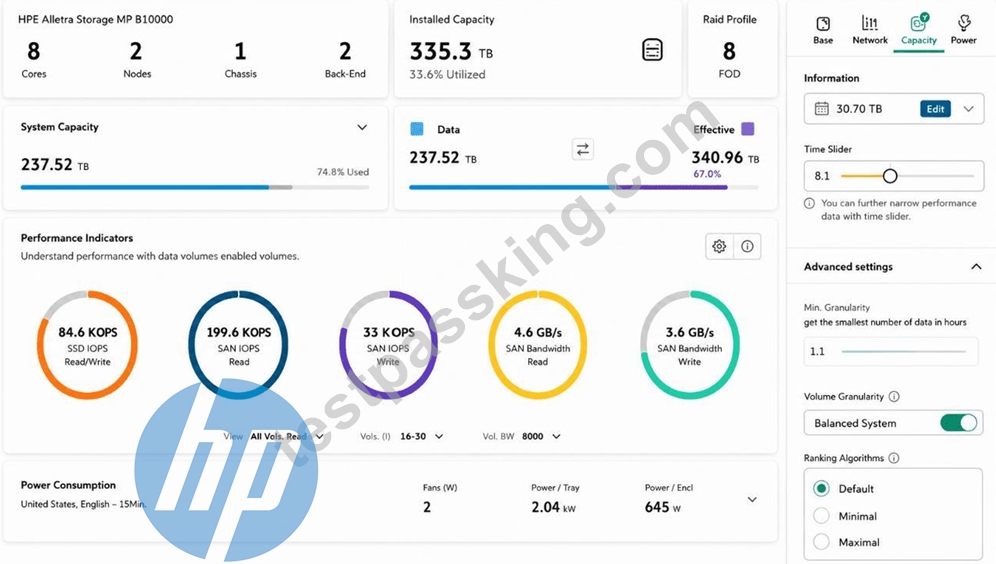
What change should you make to the configuration to achieve this?
- A. Replace the nodes with B10230 model and add additional drive shelf and more drives.
- B. Replace the nodes with B91130 model and add additional drive shelf.
- C. Increase the amount of drives supported to achieve the requirement.
- D. Replace the nodes with B91160 model and add additional drive shelf and more drives.
Answer: A
Explanation:
The correct answer is D because the requirement is not simply additional raw capacity; it is a write- performance target of 500K IOP/s. For HPE Alletra Storage MP B10000 designs, controller-node model selection, node count, shelf count, drive population, and media layout collectively determine whether the configuration can satisfy the performance envelope. Merely increasing the number of drives, as suggested in option C, does not guarantee that the front-end controller resources, CPU, cache, and back-end connectivity can sustain the required write workload. Options A and B use lower or inappropriate node selections for this stated requirement. The B10230 model, combined with additional shelf and drive resources, is the configuration change that aligns the controller and media resources with the required write I/O target. HPE's course outline places HPE Alletra Storage MP B10000 in both general enterprise solution design and database workload solution design, which is exactly the kind of workload-sensitive sizing exercise represented here. The proposal must be validated against the customer's required I/O profile, not only against usable capacity.
NEW QUESTION # 28
You are validating the hardware architecture for an AI solution.
Your customer has requested that you focus on possible upgrades for their HPE ProLiant Compute DL384 Gen12 server.
Which of the following statements is correct?
- A. The GPU performance can be increased by adding more Nvidia GB200 accelerators.
- B. The 400Gb NICs can be added if liquid cooling is used with the chassis.
- C. The amount of supported EDSFF drives depends on the selected RAID controller.
- D. The Superchips on the server include a fixed amount for the memory configuration.
Answer: D
Explanation:
The correct answer is B. The HPE ProLiant Compute DL384 Gen12 is an AI-optimized server platform built around NVIDIA Grace Hopper Superchip architecture. In this class of design, the CPU/GPU complex and high-bandwidth memory are integrated as part of the Superchip module rather than being expanded like conventional DIMM-based system memory. The HPE DL384 Gen12 data sheet describes the platform as using NVIDIA GH200 NVL2 Superchips and highlights coherent memory and memory bandwidth characteristics, which is exactly why the memory configuration is treated as tied to the Superchip selection. Option A is incorrect because the DL384 Gen12 architecture is not upgraded by freely adding more GB200 accelerators; it is based on a defined Grace Hopper Superchip platform. Option C is incorrect because EDSFF drive support is a platform/backplane architecture consideration, not simply a RAID-controller dependency. Option D is also not the governing rule for
400Gb NIC support. Reference/topics: AI server architecture, DL384 Gen12, NVIDIA GH200/NVL2, Superchip memory architecture, hardware validation.
NEW QUESTION # 29
Your customer is planning to buy a new hardware platform for their HPC application.
They are considering an environment with 150 HPE Cray XD2000 systems with XD225v and XD220v servers.
Your customer has the following requirements for a management platform:
* Supports Ubuntu Linux 24.04 operating system
* Supports bare metal server operating system provisioning
* Has the ability to install operating system in parallel on multiple nodes
* Management platform is highly available
You are exploring HPE Performance Cluster Manager (HPCM) as a solution.
What statement is true in this scenario?
- A. HPE Performance Cluster Manager will fit the customer's requirements.
- B. One server node must be reserved for the Admin Node.
- C. A different management solution must be used for parallel OS installation.
- D. The Slingshot network component must be added to the solution.
Answer: A
Explanation:
The correct answer is A. HPE Performance Cluster Manager is the correct management platform for this HPC-oriented customer because it is designed for large-scale cluster administration, operating system provisioning, image management, monitoring, and lifecycle operations. The key requirement is not only to install an operating system, but to do so across many nodes efficiently. HPE Performance Cluster Manager supports bare-metal Linux provisioning and can provision nodes in parallel, which directly addresses the customer's requirement for simultaneous operating system deployment across the 150-node environment. HPE's QuickSpecs state that HPCM can quickly provision a Linux operating system from bare metal and provision nodes in parallel for maximum system performance, including very large clusters. Option B is not the best statement because the design normally uses dedicated management infrastructure and, for high availability, management roles are planned as part of the cluster architecture rather than reserving one arbitrary server node. Option C is false because parallel OS installation is a core HPCM function. Option D is false because Slingshot is not required merely to satisfy the management-platform requirements listed. Reference/topics: HPCM, HPC cluster management, bare-metal provisioning, parallel deployment, high-availability management.
NEW QUESTION # 30
Your customer plans to deploy multiple virtual machines running database workloads. They plan to re-use and extend an existing Synergy, 3PAR, and VMware infrastructure.
What is true regarding a possible upgrade?
- A. HPE OneView can be used for rapid VM deployment.
- B. HPE OneView for Ansible Orchestrator can be used to deploy the operating system to new ESXi hosts.
- C. HPE OneView for VMware vCenter can be used to deploy additional ESXi hosts.
- D. HPE 3PAR cannot be used with VMware infrastructure running on Synergy.
Answer: C
Explanation:
The correct answer is A because HPE OneView for VMware vCenter provides VMware administrators with integrated HPE infrastructure management from within vCenter and supports deployment workflows for ESXi hosts on supported HPE platforms such as HPE Synergy and HPE ProLiant. In this scenario, the customer already has a Synergy, 3PAR, and VMware environment and wants to extend it for additional virtual machines running database workloads. Adding ESXi hosts through the HPE OneView for VMware vCenter integration is a valid upgrade path because it aligns server provisioning and VMware lifecycle operations with the existing management model. Option B is incorrect because it confuses infrastructure automation with the specific HPE OneView for VMware vCenter ESXi deployment function. Option C is false because HPE 3PAR has long been supported in VMware environments and can be part of Synergy-based infrastructure. Option D is imprecise: HPE OneView composes and manages infrastructure; it is not primarily a rapid VM deployment tool. The course covers database workload architectures, Synergy, HPE storage, VMware integration, and the use of HPE tools for validated traditional solution design.
NEW QUESTION # 31
Your customer has a combination of HPE and non-HPE equipment.
Which is the correct functionality available in Aruba Fabric Composer for this customer's environment?
- A. Management of Pensando cards in the servers.
- B. Management and monitoring of HPE Alletra Storage MP B10000 arrays.
- C. VLAN visibility of VMware on non-HPE servers.
- D. Configuration of SAN zoning on ArubaOS-CX 8400 switches.
Answer: C
NEW QUESTION # 32
Your customer's environment includes HPE Private Cloud Business Edition with deployed HPE SimpliVity
380 Gen11 nodes.
They have asked you to upgrade the vSphere, OmniStack, and firmware components of the environment in a fully controlled operation.
Which tool should you use?
- A. HPE OVC/HPC plugin and vCenter Update Manager
- B. HPE GreenLake / DSCC / PCBE site upgrade
- C. HPE SimpliVity Upgrade Manager application
- D. HPE OCA/HPC plugin and vCenter Update Manager
Answer: B
Explanation:
The correct answer is A. In an HPE Private Cloud Business Edition environment, the proper operational model is to use the HPE GreenLake / Data Services Cloud Console workflow for system- level lifecycle activities rather than treating the environment as a standalone SimpliVity-only deployment. HPE documentation for Private Cloud Business Edition identifies Data Services Cloud Console as the interface used to set up, upgrade, and manage PCBE environments, and the "Updating system software" workflow is specifically tied to PCBE administration through DSCC. The customer's requirement is broader than a single OmniStack upgrade: it includes vSphere, OmniStack, and firmware in a controlled operation. That makes a PCBE site-upgrade workflow the best match. Option B is associated with traditional SimpliVity software and firmware upgrade processes, but it is not the most complete answer for a PCBE-managed environment. Options C and D mix plugin/update- manager concepts and do not represent the correct PCBE lifecycle mechanism. Reference/topics: PCBE lifecycle operations, DSCC, SimpliVity upgrade planning, HPE GreenLake operational management.
NEW QUESTION # 33
Your customer wants to implement an HPE SimpliVity stretched cluster spanning two sites to improve availability.
You are reviewing an HPE SimpliVity proposal that consists of the following components:
* 12 HPE SimpliVity 380 Gen11 nodes, 8 for the primary site and 4 for the remote site, all of which have
2 CPUs, 16 cores each
* 12 HPE OneView Advanced licenses
* 2 HPE Alletra Storage MP B10000, 1 for the primary site and 1 for the remote site
* 384 core VMware vSphere Standard subscriptions
* Two pairs of ArubaOS-CX 8325 switches
Which statement about this proposal is true?
- A. A Remote Copy license should be activated on all HPE Alletra arrays to enable remote HPE SimpliVity backups.
- B. In order to enable DRS functionality, vSphere Standard subscriptions should be replaced with vSphere Foundation subscriptions.
- C. Additional VMware subscriptions should be added, as the HPE SimpliVity 380 Gen11 core count is higher than needed.
- D. Aruba OS-CX 8325 should be enhanced with a Pensando license so HPE SimpliVity traffic can be secured.
Answer: B
Explanation:
The correct answer is B. The proposal includes VMware vSphere Standard subscriptions, but the requirement context is a stretched, availability-focused HPE SimpliVity design. Distributed Resource Scheduler is an advanced VMware function used for automated VM placement and load balancing across hosts. VMware's product-line comparison shows Distributed Resource Scheduler under Enterprise Plus and vSphere Foundation feature sets, while vSphere Standard does not provide that capability. Therefore, if the customer requires DRS functionality, vSphere Standard must be replaced with an edition that includes DRS, such as vSphere Foundation. Option A is incorrect because the listed core count is aligned with 12 nodes x 2 CPUs x 16 cores, which totals 384 cores; the issue is not missing core quantity. Option C is incorrect because HPE Alletra Remote Copy licensing is unrelated to enabling HPE SimpliVity backup behavior. Option D is not required to make a SimpliVity stretched cluster valid; Pensando is a distributed services/security acceleration technology, not a prerequisite for SimpliVity stretched-cluster traffic. Reference/topics: proposal validation, VMware subscription selection, SimpliVity stretched cluster design, licensing alignment.
NEW QUESTION # 34
Your customer would like to implement Peer Persistence for their HPE Alletra 6000 remote replication configuration.
Which two statements are true? (Select two.)
- A. The upstream volume reports active paths; downstream reports standby.
- B. Downstream array works as a witness.
- C. Peer Persistence only works for FC host connectivity.
- D. Upstream array works as a witness.
- E. Both arrays can host upstream and downstream volumes.
Answer: A,E
Explanation:
The correct answers are B and C. In HPE Alletra 6000 / NimbleOS synchronous replication and Peer Persistence designs, the upstream and downstream volume relationship determines the active and standby host path behavior. HPE documentation states that when synchronous replication is configured, upstream and downstream volumes share the same serial number, and host paths are presented so that active paths are mapped to the upstream volume while standby paths are mapped to the downstream volume. That validates option B. Option C is also correct because in a bidirectional design, each array can host upstream volumes for some protected workloads and downstream volumes for others; the role is per replicated volume collection, not a permanent identity of the entire array.
Options A and D are wrong because the witness is a separate arbitration component, not the upstream or downstream array. Option E is wrong because Alletra 6000 synchronous replication uses Ethernet connectivity between arrays, and Peer Persistence is not limited to FC-only host access. Reference
/topics: HPE Alletra 6000 Peer Persistence, synchronous replication, upstream/downstream roles, witness design.
NEW QUESTION # 35
Your customer wants to implement a disaster recovery solution for their virtualization workload. They also want to implement a protection method that will protect the workload in case of a site failure.
Their existing environment includes the following configurations:
* All ESXi systems are located in the same datacenter
* Virtual machines are protected by an HA cluster
* Some of the VMs are protected with Fault Tolerance
* HPE Synergy 480 Gen11 is the compute platform
* HPE Alletra Storage MP B10000 array for storage
* Orchestrated failover for all VMs using VMware tools
The customer plans to replicate the same setup at the second site. The total number of virtual machines that must be protected is 200. Your customer also expects an RPO of 0.
Which component or configuration is a necessary part of a solution that will meet all customer requirements?
- A. Storage policy-based management (SPBM) must be configured for a group of the virtual machines.
- B. Asynchronous replication configured between sites used to replicate the volumes used to build the datastores.
- C. Synchronous replication configured between sites to replicate the volumes used to build the datastores.
- D. HPE Synergy frames from the secondary site added to the logical enclosure configured in the primary site.
Answer: C
Explanation:
The correct answer is C. RPO 0 is the decisive requirement. A zero recovery point objective means the customer cannot lose acknowledged writes if a site fails. That requirement cannot be satisfied by asynchronous replication because asynchronous copy always introduces replication lag. The storage volumes backing the VMware datastores must be synchronously replicated between the two sites so that committed data exists at both locations before the write is considered protected. HPE Alletra Storage MP B10000 is designed for mission-critical block workloads and supports high-availability replication models, including synchronous Remote Copy / Peer Persistence designs for VMware environments. HPE documentation for Active Peer Persistence describes synchronous Remote Copy as the mechanism used for high-availability protection across arrays. Option A is incorrect because stretching or joining HPE Synergy frames across sites is not the mechanism that provides RPO 0.
Option B can help with VMware policy-driven placement, but SPBM alone does not replicate data.
Option D fails the RPO requirement. Reference/topics: DR architecture, RPO 0, synchronous replication, B10000 Remote Copy, VMware datastore protection.
NEW QUESTION # 36
Which statement about HPE SimpliVity is true?
- A. A single Intel-based HPE SimpliVity node can support up to 8 non-HPE SimpliVity servers.
- B. Mixing AMD and Intel chassis in the same federation is fully supported.
- C. HPE SimpliVity 380 Gen11 cluster with compute nodes requires the same CPU in all nodes.
- D. A single AMD-based HPE SimpliVity node can support up to 4 non-HPE SimpliVity servers.
Answer: A
Explanation:
The correct answer is D. In HPE SimpliVity designs, non-HPE SimpliVity compute nodes can be added to consume the storage and data services provided by SimpliVity nodes, but the supported ratio depends on the validated SimpliVity platform and processor family. For Intel-based HPE SimpliVity nodes, the supported design rule in this context allows up to eight non-HPE SimpliVity servers per SimpliVity node. Option A is incorrect because compute-node designs do not require identical CPUs across every server in the way stated; compatibility and supportability are governed by the validated platform, hypervisor, cluster, and SimpliVity federation rules. Option B is too broad and unsafe:
mixing processor families and chassis types inside the same federation is controlled by strict HPE support matrices and is not "fully supported" as a general rule. Option C gives the wrong AMD-based ratio for the scenario. HPE SimpliVity 380 Gen11 is documented as an Intel Xeon-based platform and is positioned for hyperconverged infrastructure with VM-centric management, data efficiency, backup, and disaster recovery. Reference/topics: SimpliVity sizing rules, compute-node attachment, federation design, HCI platform validation.
NEW QUESTION # 37
Your customer requires a data protection solution that will support their workloads running on an HPE Alletra MP B10000 storage array.
Your customer requirements include:
* Protecting VMware vSphere workloads
* Covering different hypervisors
* Pay-per-use model
* Near synchronous and block-level replication
Select the most appropriate solution.
- A. HPE Alletra Storage Server 4120
- B. HPE Data Ops Manager
- C. HPE Zerto
- D. HPE StoreOnce 3660
Answer: C
Explanation:
The correct answer is A. HPE Zerto is the appropriate solution because the requirements describe application and VM-level cyber resilience/disaster recovery, not array management or backup-target hardware. Zerto protects virtualized workloads using near-synchronous, block-level replication and journal-based recovery, which supports very low RPOs and granular recovery points. HPE's Zerto product material describes near-synchronous replication with recovery points measured in seconds, and HPE GreenLake for Disaster Recovery uses Zerto continuous data protection in a cloud-service model. Option B is incorrect because HPE Data Ops Manager manages HPE block storage operations and data services; it is not the DR engine for cross-hypervisor workload replication. Option C is a storage-server platform and does not provide the requested VM-level replication service. Option D, HPE StoreOnce, is a backup appliance target; it is valuable for backup retention and deduplication but does not provide near-synchronous, block-level VM replication across hypervisors. Reference/topics:
HPE Zerto, HPE GreenLake for Disaster Recovery, VMware workload protection, pay-per-use data protection, block-level replication.
NEW QUESTION # 38
Your customer has a combination of HPE and non-HPE equipment.
What is the correct functionality available in Aruba Fabric Composer for this customer's environment?
- A. Management and monitoring of HPE Alletra Storage MP B10000 arrays.
- B. Configuration of SAN zoning on ArubaOS-CX 8400 switches.
- C. Acceleration of spine-leaf fabric provisioning on ArubaOS-CX switches.
- D. Management and monitoring of HPE Synergy Virtual Connect.
Answer: C
NEW QUESTION # 39
......
Feel HP HPE7-V01 Dumps PDF Will likely be The best Option: https://www.testpassking.com/HPE7-V01-exam-testking-pass.html