

Latest [Sep 16, 2021] DP-203 Exam with Accurate Data Engineering on Microsoft Azure PDF Questions
Take a Leap Forward in Your Career by Earning Microsoft 149 Questions
NEW QUESTION 29
A company plans to use Platform-as-a-Service (PaaS) to create the new data pipeline process. The process must meet the following requirements:
Ingest:
Access multiple data sources.
Provide the ability to orchestrate workflow.
Provide the capability to run SQL Server Integration Services packages.
Store:
Optimize storage for big data workloads.
Provide encryption of data at rest.
Operate with no size limits.
Prepare and Train:
Provide a fully-managed and interactive workspace for exploration and visualization.
Provide the ability to program in R, SQL, Python, Scala, and Java.
Provide seamless user authentication with Azure Active Directory.
Model & Serve:
Implement native columnar storage.
Support for the SQL language
Provide support for structured streaming.
You need to build the data integration pipeline.
Which technologies should you use? To answer, select the appropriate options in the answer area.
NOTE: Each correct selection is worth one point.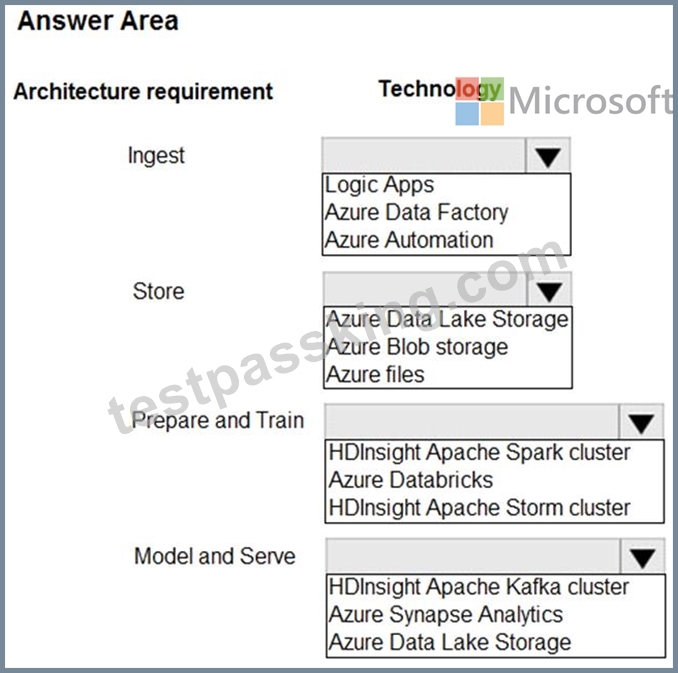
Answer:
Explanation: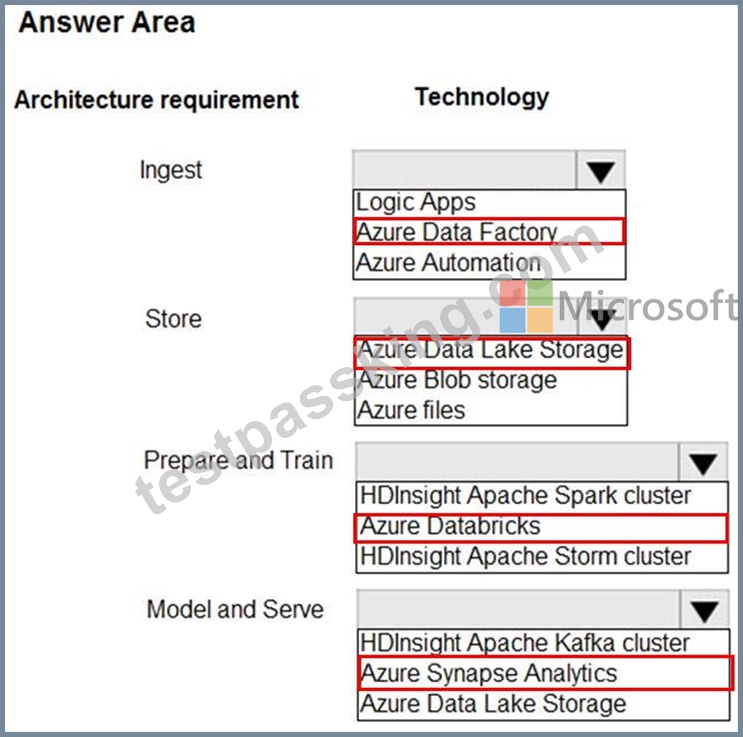
NEW QUESTION 30
You need to integrate the on-premises data sources and Azure Synapse Analytics. The solution must meet the data integration requirements.
Which type of integration runtime should you use?
- A. self-hosted integration runtime
- B. Azure-SSIS integration runtime
- C. Azure integration runtime
Answer: B
NEW QUESTION 31
You have an Azure Data Lake Storage Gen2 container.
Data is ingested into the container, and then transformed by a data integration application. The data is NOT modified after that. Users can read files in the container but cannot modify the files.
You need to design a data archiving solution that meets the following requirements:
New data is accessed frequently and must be available as quickly as possible.
Data that is older than five years is accessed infrequently but must be available within one second when requested.
Data that is older than seven years is NOT accessed. After seven years, the data must be persisted at the lowest cost possible.
Costs must be minimized while maintaining the required availability.
How should you manage the data? To answer, select the appropriate options in the answer are a.
NOTE: Each correct selection is worth one point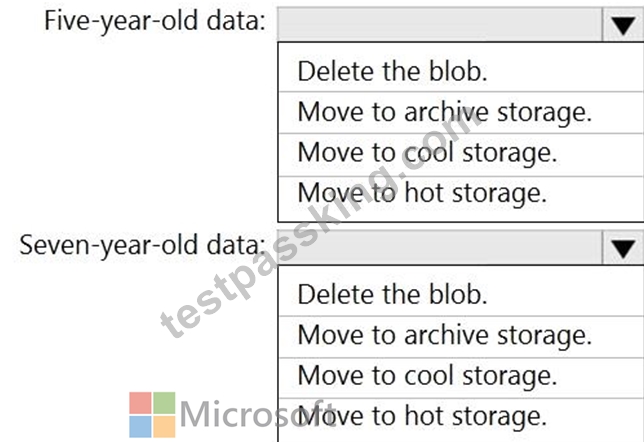
Answer:
Explanation: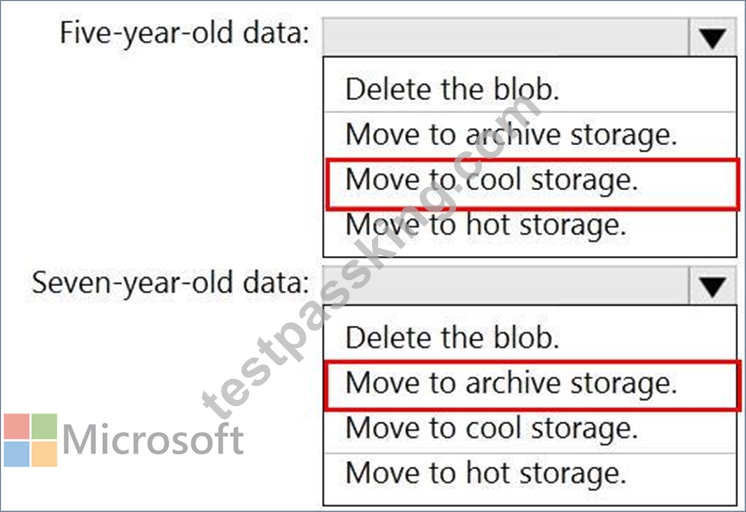
Reference:
https://docs.microsoft.com/en-us/azure/storage/blobs/storage-blob-storage-tiers
https://azure.microsoft.com/en-us/updates/reduce-data-movement-and-make-your-queries-more-efficient-with-the-general-availability-of-replicated-tables/
https://azure.microsoft.com/en-us/blog/replicated-tables-now-generally-available-in-azure-sql-data-warehouse/
NEW QUESTION 32
You have an on-premises data warehouse that includes the following fact tables. Both tables have the following columns: DateKey, ProductKey, RegionKey. There are 120 unique product keys and 65 unique region keys.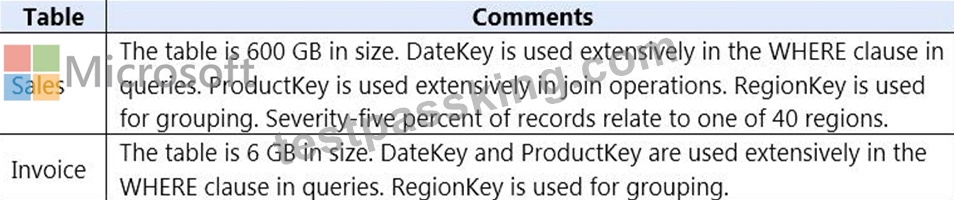
Queries that use the data warehouse take a long time to complete.
You plan to migrate the solution to use Azure Synapse Analytics. You need to ensure that the Azure-based solution optimizes query performance and minimizes processing skew.
What should you recommend? To answer, select the appropriate options in the answer area.
NOTE: Each correct selection is worth one point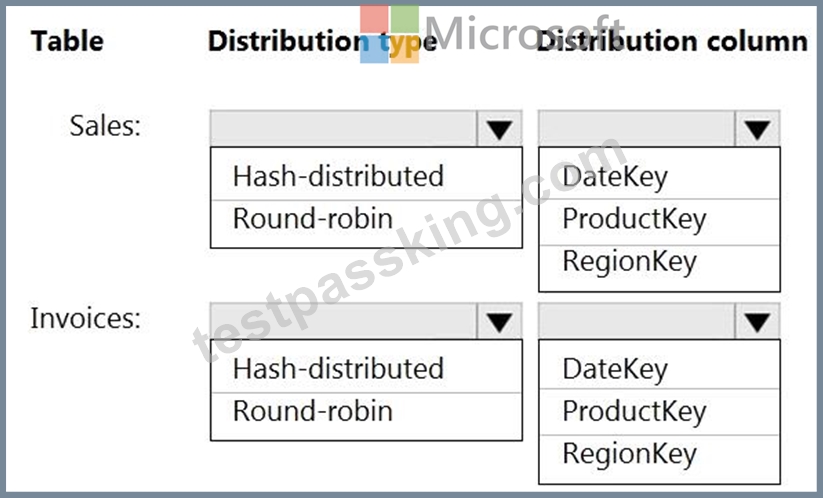
Answer:
Explanation: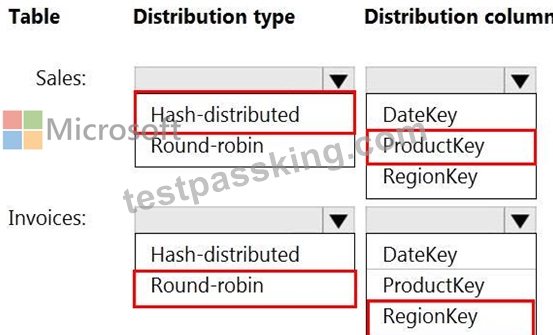
Reference:
https://docs.microsoft.com/en-us/azure/sql-data-warehouse/sql-data-warehouse-tables-distribute
NEW QUESTION 33
You use Azure Data Factory to prepare data to be queried by Azure Synapse Analytics serverless SQL pools.
Files are initially ingested into an Azure Data Lake Storage Gen2 account as 10 small JSON files. Each file contains the same data attributes and data from a subsidiary of your company.
You need to move the files to a different folder and transform the data to meet the following requirements:
Provide the fastest possible query times.
Automatically infer the schema from the underlying files.
How should you configure the Data Factory copy activity? To answer, select the appropriate options in the answer are a.
NOTE: Each correct selection is worth one point.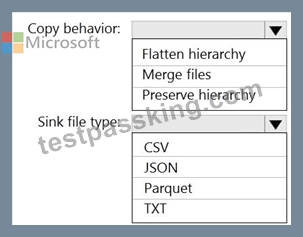
Answer:
Explanation: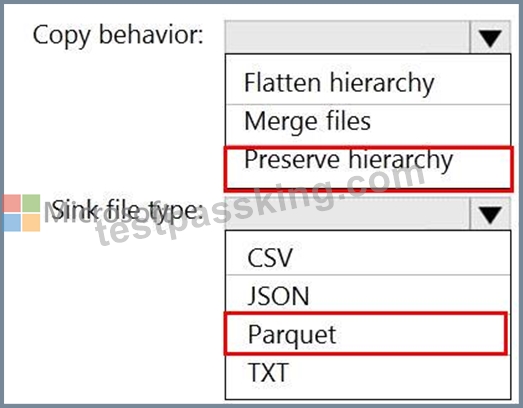
Reference:
https://docs.microsoft.com/en-us/azure/storage/blobs/data-lake-storage-introduction
https://docs.microsoft.com/en-us/azure/data-factory/format-parquet
NEW QUESTION 34
You have the following table named Employees.
You need to calculate the employee _type value based on the hire date value.
How should you complete the Transact-SQL statement? To answer, drag the appropriate values to the correct targets. Each value may be used once, more than once, or not at all. You may need to drag the split bar between panes or scroll to view content- NOTE: Each correct selection is worth one point.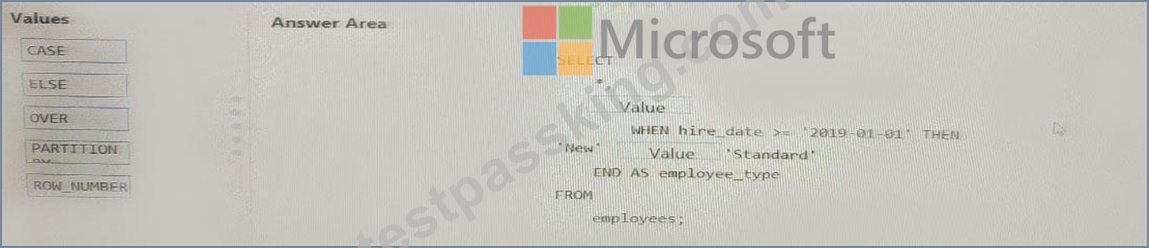
Answer:
Explanation: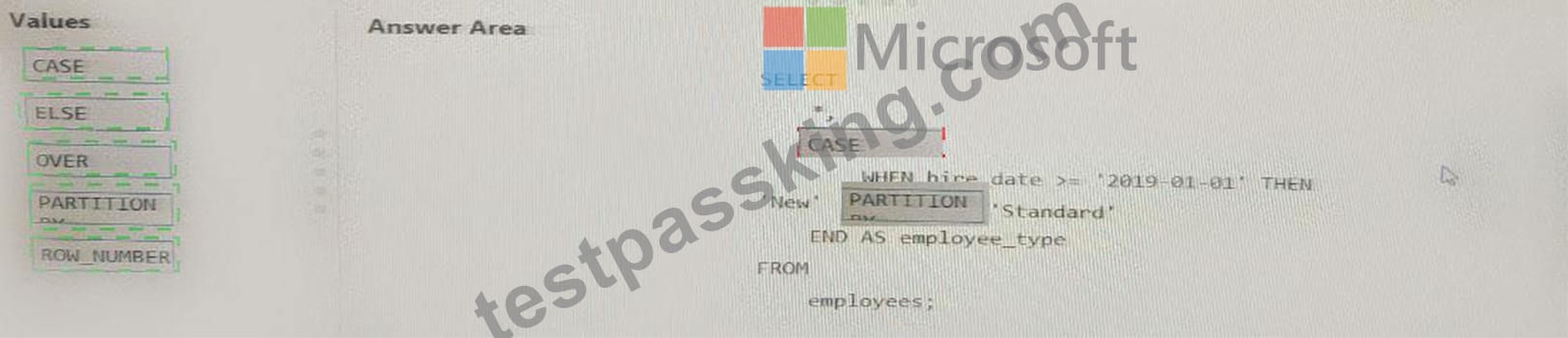
NEW QUESTION 35
You need to ensure that the Twitter feed data can be analyzed in the dedicated SQL pool. The solution must meet the customer sentiment analytics requirements.
Which three Transaction-SQL DDL commands should you run in sequence? To answer, move the appropriate commands from the list of commands to the answer area and arrange them in the correct order.
NOTE: More than one order of answer choices is correct. You will receive credit for any of the correct orders you select.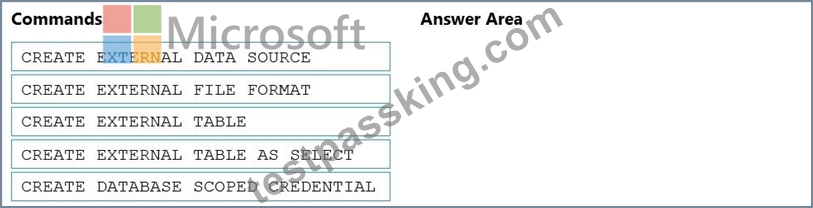
Answer:
Explanation: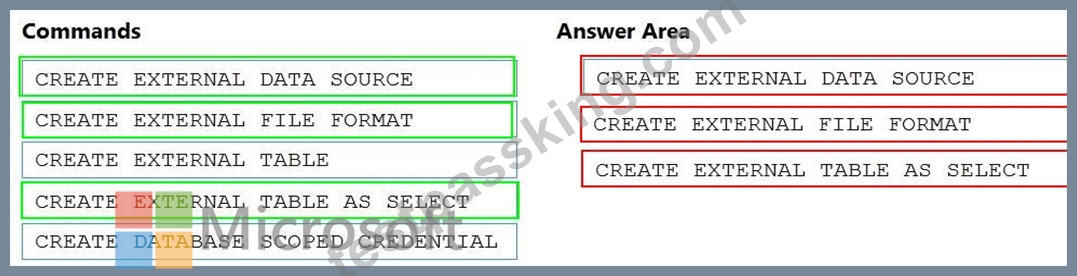
Reference:
https://docs.microsoft.com/en-us/azure/synapse-analytics/sql/develop-tables-external-tables
Topic 2, Litware, inc.
Overview
Litware, Inc. owns and operates 300 convenience stores across the US. The company sells a variety of packaged foods and drinks, as well as a variety of prepared foods, such as sandwiches and pizzas.
Litware has a loyalty club whereby members can get daily discounts on specific items by providing their membership number at checkout.
Litware employs business analysts who prefer to analyze data by using Microsoft Power BI, and data scientists who prefer analyzing data in Azure Databricks notebooks.
Requirements
Business Goals
Litware wants to create a new analytics environment in Azure to meet the following requirements:
See inventory levels across the stores. Data must be updated as close to real time as possible.
Execute ad hoc analytical queries on historical data to identify whether the loyalty club discounts increase sales of the discounted products.
Every four hours, notify store employees about how many prepared food items to produce based on historical demand from the sales data.
Technical Requirements
Litware identifies the following technical requirements:
Minimize the number of different Azure services needed to achieve the business goals.
Use platform as a service (PaaS) offerings whenever possible and avoid having to provision virtual machines that must be managed by Litware.
Ensure that the analytical data store is accessible only to the company's on-premises network and Azure services.
Use Azure Active Directory (Azure AD) authentication whenever possible.
Use the principle of least privilege when designing security.
Stage Inventory data in Azure Data Lake Storage Gen2 before loading the data into the analytical data store. Litware wants to remove transient data from Data Lake Storage once the data is no longer in use. Files that have a modified date that is older than 14 days must be removed.
Limit the business analysts' access to customer contact information, such as phone numbers, because this type of data is not analytically relevant.
Ensure that you can quickly restore a copy of the analytical data store within one hour in the event of corruption or accidental deletion.
Planned Environment
Litware plans to implement the following environment:
The application development team will create an Azure event hub to receive real-time sales data, including store number, date, time, product ID, customer loyalty number, price, and discount amount, from the point of sale (POS) system and output the data to data storage in Azure.
Customer data, including name, contact information, and loyalty number, comes from Salesforce, a SaaS application, and can be imported into Azure once every eight hours. Row modified dates are not trusted in the source table.
Product data, including product ID, name, and category, comes from Salesforce and can be imported into Azure once every eight hours. Row modified dates are not trusted in the source table.
Daily inventory data comes from a Microsoft SQL server located on a private network.
Litware currently has 5 TB of historical sales data and 100 GB of customer data. The company expects approximately 100 GB of new data per month for the next year.
Litware will build a custom application named FoodPrep to provide store employees with the calculation results of how many prepared food items to produce every four hours.
Litware does not plan to implement Azure ExpressRoute or a VPN between the on-premises network and Azure.
NEW QUESTION 36
You are designing a slowly changing dimension (SCD) for supplier data in an Azure Synapse Analytics dedicated SQL pool.
You plan to keep a record of changes to the available fields.
The supplier data contains the following columns.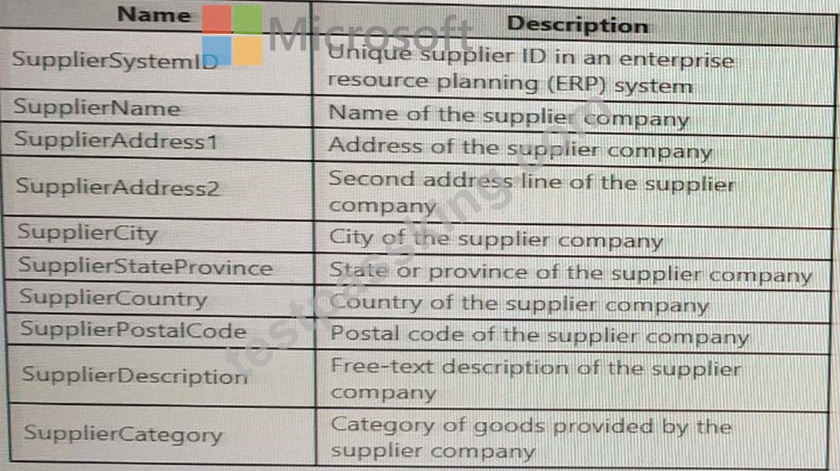
Which three additional columns should you add to the data to create a Type 2 SCD? Each correct answer presents part of the solution.
NOTE: Each correct selection is worth one point.
- A. surrogate primary key
- B. effective start date
- C. effective end date
- D. business key
- E. last modified date
- F. foreign key
Answer: B,D,F
NEW QUESTION 37
You are designing a sales transactions table in an Azure Synapse Analytics dedicated SQL pool. The table will contains approximately 60 million rows per month and will be partitioned by month. The table will use a clustered column store index and round-robin distribution.
Approximately how many rows will there be for each combination of distribution and partition?
- A. 1 million
- B. 5 million
- C. 20 million
- D. 60 million
Answer: D
Explanation:
Explanation
https://docs.microsoft.com/en-us/azure/synapse-analytics/sql-data-warehouse/sql-data-warehouse-tables-partitio
NEW QUESTION 38
You have an Azure Active Directory (Azure AD) tenant that contains a security group named Group1. You have an Azure Synapse Analytics dedicated SQL pool named dw1 that contains a schema named schema1.
You need to grant Group1 read-only permissions to all the tables and views in schema1. The solution must use the principle of least privilege.
Which three actions should you perform in sequence? To answer, move the appropriate actions from the list of actions to the answer area and arrange them in the correct order.
NOTE: More than one order of answer choices is correct. You will receive credit for any of the correct orders you select.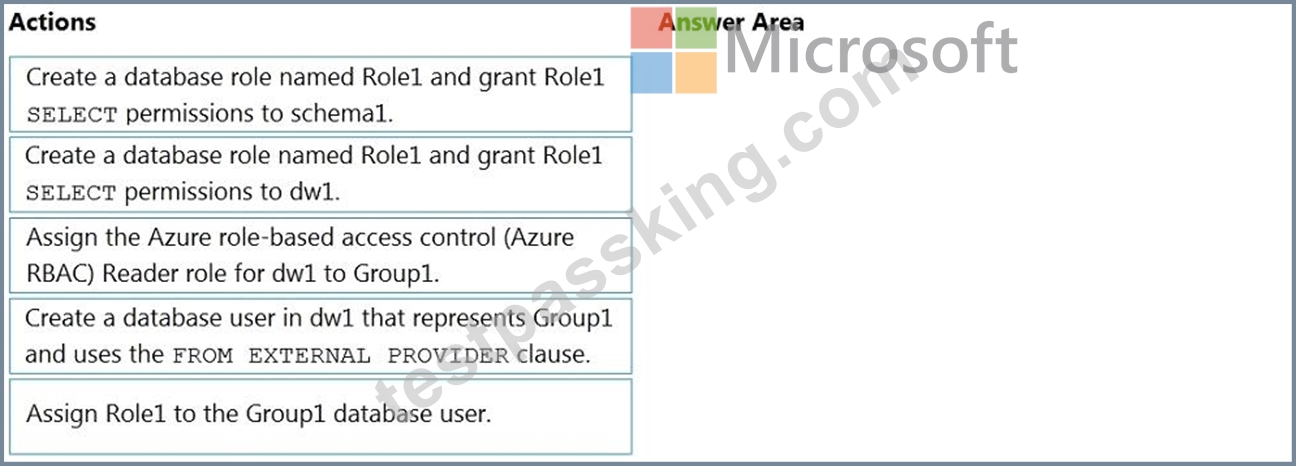
Answer:
Explanation: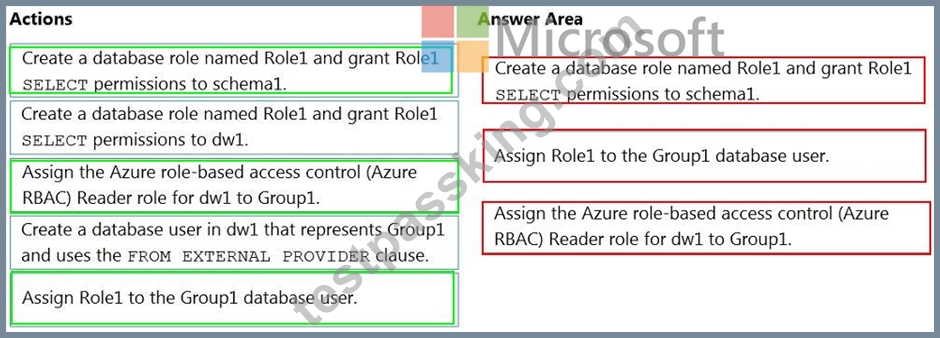
Reference:
https://docs.microsoft.com/en-us/azure/data-share/how-to-share-from-sql
NEW QUESTION 39
You are designing a monitoring solution for a fleet of 500 vehicles. Each vehicle has a GPS tracking device that sends data to an Azure event hub once per minute.
You have a CSV file in an Azure Data Lake Storage Gen2 container. The file maintains the expected geographical area in which each vehicle should be.
You need to ensure that when a GPS position is outside the expected area, a message is added to another event hub for processing within 30 seconds. The solution must minimize cost.
What should you include in the solution? To answer, select the appropriate options in the answer area.
NOTE: Each correct selection is worth one point.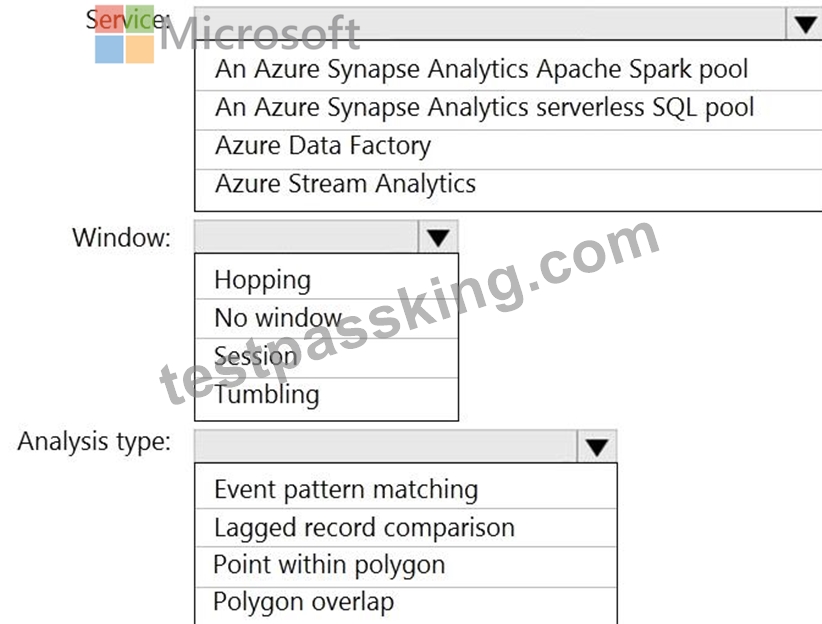
Answer:
Explanation: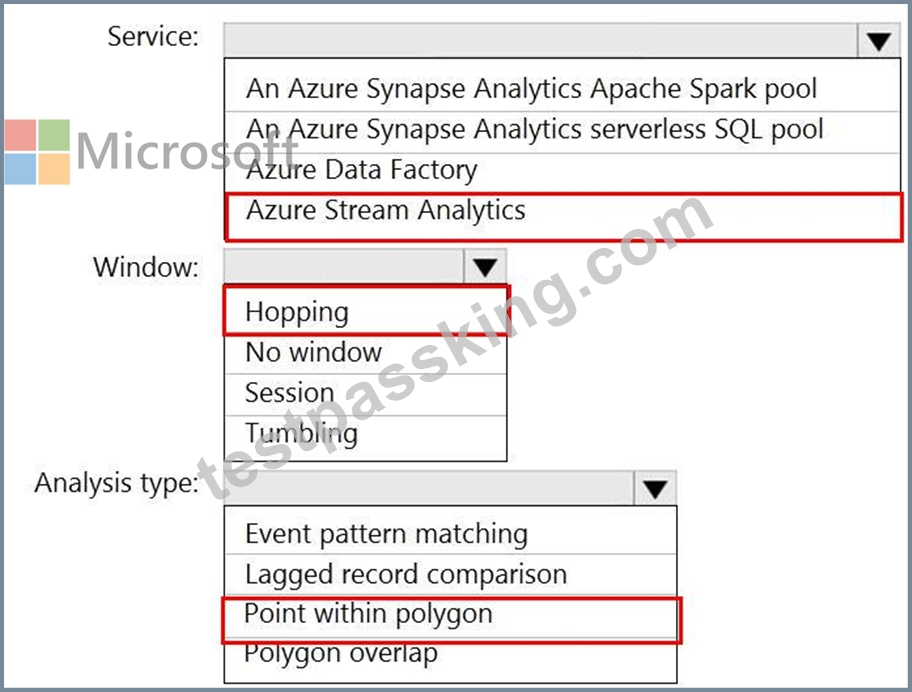
Reference:
https://docs.microsoft.com/en-us/azure/stream-analytics/stream-analytics-window-functions
NEW QUESTION 40
You need to design a data storage structure for the product sales transactions. The solution must meet the sales transaction dataset requirements.
What should you include in the solution? To answer, select the appropriate options in the answer area.
NOTE: Each correct selection is worth one point.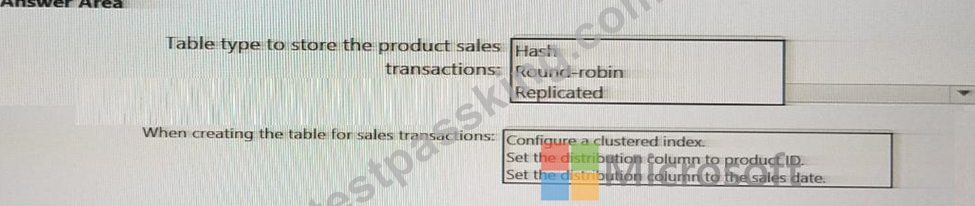
Answer:
Explanation: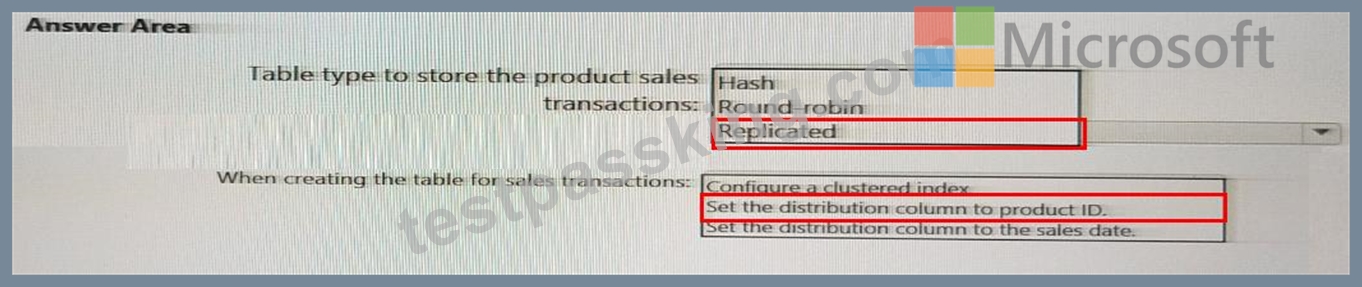
NEW QUESTION 41
You plan to monitor an Azure data factory by using the Monitor & Manage app.
You need to identify the status and duration of activities that reference a table in a source database.
Which three actions should you perform in sequence? To answer, move the actions from the list of actions to the answer are and arrange them in the correct order.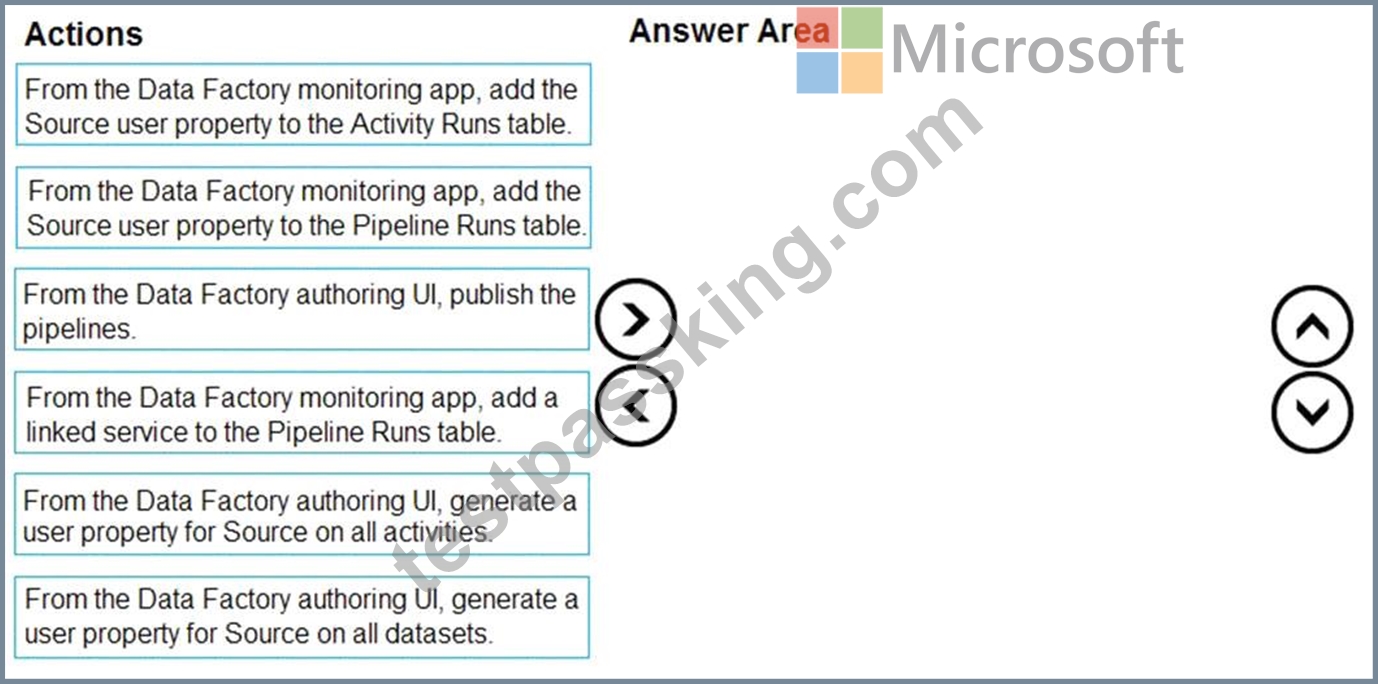
Answer:
Explanation: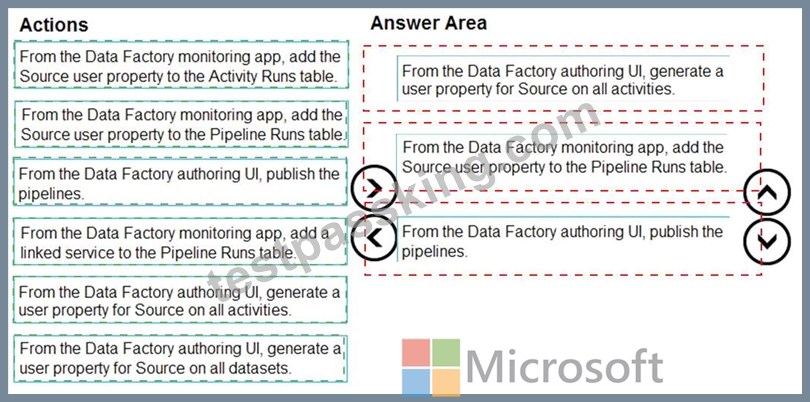
Explanation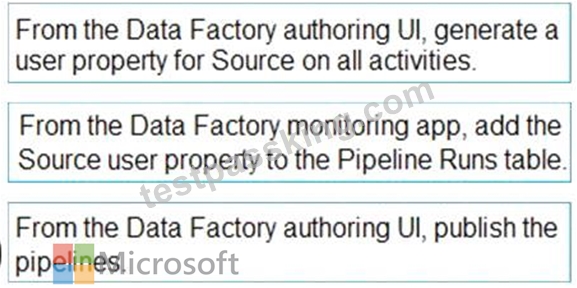
Step 1: From the Data Factory authoring UI, generate a user property for Source on all activities.
Step 2: From the Data Factory monitoring app, add the Source user property to Activity Runs table.
You can promote any pipeline activity property as a user property so that it becomes an entity that you can monitor. For example, you can promote the Source and Destination properties of the copy activity in your pipeline as user properties. You can also select Auto Generate to generate the Source and Destination user properties for a copy activity.
Step 3: From the Data Factory authoring UI, publish the pipelines
Publish output data to data stores such as Azure SQL Data Warehouse for business intelligence (BI) applications to consume.
References:
https://docs.microsoft.com/en-us/azure/data-factory/monitor-visually
NEW QUESTION 42
You have an Azure data solution that contains an enterprise data warehouse in Azure Synapse Analytics named DW1.
Several users execute ad hoc queries to DW1 concurrently.
You regularly perform automated data loads to DW1.
You need to ensure that the automated data loads have enough memory available to complete quickly and successfully when the adhoc queries run.
What should you do?
- A. Assign a smaller resource class to the automated data load queries.
- B. Hash distribute the large fact tables in DW1 before performing the automated data loads.
- C. Create sampled statistics for every column in each table of DW1.
- D. Assign a larger resource class to the automated data load queries.
Answer: D
Explanation:
The performance capacity of a query is determined by the user's resource class. Resource classes are pre-determined resource limits in Synapse SQL pool that govern compute resources and concurrency for query execution.
Resource classes can help you configure resources for your queries by setting limits on the number of queries that run concurrently and on the compute-resources assigned to each query. There's a trade-off between memory and concurrency.
Smaller resource classes reduce the maximum memory per query, but increase concurrency.
Larger resource classes increase the maximum memory per query, but reduce concurrency.
Reference:
https://docs.microsoft.com/en-us/azure/synapse-analytics/sql-data-warehouse/resource-classes-for-workload-management
NEW QUESTION 43
You have a partitioned table in an Azure Synapse Analytics dedicated SQL pool.
You need to design queries to maximize the benefits of partition elimination.
What should you include in the Transact-SQL queries?
- A. DISTINCT
- B. GROUP BY
- C. JOIN
- D. WHERE
Answer: D
NEW QUESTION 44
Note: This question is part of a series of questions that present the same scenario. Each question in the series contains a unique solution that might meet the stated goals. Some question sets might have more than one correct solution, while others might not have a correct solution.
After you answer a question in this scenario, you will NOT be able to return to it. As a result, these questions will not appear in the review screen.
You have an Azure Storage account that contains 100 GB of files. The files contain text and numerical values. 75% of the rows contain description data that has an average length of 1.1 MB.
You plan to copy the data from the storage account to an enterprise data warehouse in Azure Synapse Analytics.
You need to prepare the files to ensure that the data copies quickly.
Solution: You convert the files to compressed delimited text files.
Does this meet the goal?
- A. No
- B. Yes
Answer: B
Explanation:
Explanation
All file formats have different performance characteristics. For the fastest load, use compressed delimited text files.
Reference:
https://docs.microsoft.com/en-us/azure/sql-data-warehouse/guidance-for-loading-data
NEW QUESTION 45
You use Azure Data Factory to prepare data to be queried by Azure Synapse Analytics serverless SQL pools.
Files are initially ingested into an Azure Data Lake Storage Gen2 account as 10 small JSON files. Each file contains the same data attributes and data from a subsidiary of your company.
You need to move the files to a different folder and transform the data to meet the following requirements:
Provide the fastest possible query times.
Automatically infer the schema from the underlying files.
How should you configure the Data Factory copy activity? To answer, select the appropriate options in the answer area.
NOTE: Each correct selection is worth one point.
Answer:
Explanation: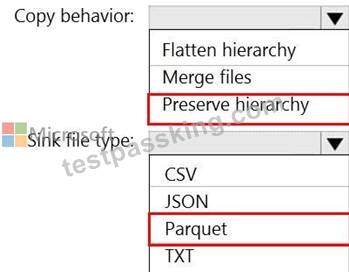
Reference:
https://docs.microsoft.com/en-us/azure/storage/blobs/data-lake-storage-introduction
https://docs.microsoft.com/en-us/azure/data-factory/format-parquet
NEW QUESTION 46
You develop data engineering solutions for a company.
A project requires the deployment of data to Azure Data Lake Storage.
You need to implement role-based access control (RBAC) so that project members can manage the Azure Data Lake Storage resources.
Which three actions should you perform? Each correct answer presents part of the solution.
NOTE: Each correct selection is worth one point.
- A. Configure access control lists (ACL) for the Azure Data Lake Storage account.
- B. Assign Azure AD security groups to Azure Data Lake Storage.
- C. Configure service-to-service authentication for the Azure Data Lake Storage account.
- D. Configure end-user authentication for the Azure Data Lake Storage account.
- E. Create security groups in Azure Active Directory (Azure AD) and add project members.
Answer: A,B,E
Explanation:
References:
https://docs.microsoft.com/en-us/azure/data-lake-store/data-lake-store-secure-data
NEW QUESTION 47
......
Authentic Best resources for DP-203 Online Practice Exam: https://www.testpassking.com/DP-203-exam-testking-pass.html
Practice To DP-203 - TestPassKing Remarkable Practice On your Data Engineering on Microsoft Azure Exam: https://drive.google.com/open?id=1N-wyRDVpfCR9bZ3jKEvlhMvUFu328RgQ